ZX Spectrum Games

ZX Spectrum Games
Showing posts with label Games - Reviews (T title). Show all posts

9 Nov 2010

Spectrum Games - The Light Corridor - Classic ZX Spectrum Game

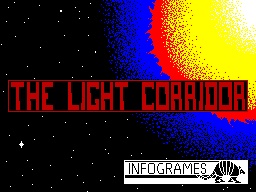
The Light Corridor ZX Spectrum
This classic game was released for the ZX Spectrum in 1991 by Infogrames. I suppose it could be classed as a sort of breakout arcade clone with a massive twist.

It was now a 3D vector graphics breakout style game, and very good it was too.

This game was released at a time when the 8-bit to 16-bit transition was gathering pace, but New Frontier software put a lot of polish on this version. If you liked breakout and puzzle games then you wouldn't go far wrong with this one...

The Light Corridor ZX SpectrumThe aim of the game was to negotiate your way along 'The Light Corridor'. Equipped with a translucent raquet you had to guide the metallic sphere (not just a ball!) from the heart of the corridor.

Avoiding the walls and the traps, you had to collect the bonuses on offer and battle your way along, until eventually you would see the light, quite literally, at the end of the tunnel.

The game was spread of four stages and in classic arcade style there were plenty of bonuses to collect and nasties to avoid.

First off, this game had one of the best pieces of title music on the ZX Spectrum ever. Even the 48K version was nicely done:


The ZX Spectrum 128 was blessed with an AY Chip, and it was majestically put through it's paces with the title music. This is one of my favourite AY tunes and showcases just how good it could sound in the hands of a talented developer. Check out this pure ear candy:


At the beginning of the game you had to release the ball and watch if fly down the corridor until it struck a wall or similar obstacle. At this point it would bounce back towards you and you had to 'hit' it with the paddle, sending it back 'away' from your viewpoint.

The player used the time the ball spent in flight to move along the corridor (you could stop and start as and when you wished). The colour of the walls also changed as you progressed further which was a nice touch.

The object of the game was to reach the end of the corridor without allowing the ball to miss the paddle and 'hit' the player. If this happened, as you might guess, it was the loss of a life.

Obstacles such as moving elevator-style doors and blocks made navigating your way quite difficult and the game was all about quick reflexes. There were also nice powerups to be had to help you on your way.

Negotiating The Light Corridor - ZX SpectrumIt must also be said that this classic game was extremely customisable.

You could run the paddle at normal or fast speed which was nice, but the real boon was being able to create your own 'corridors'. The game had an in-built editor that allowed you to create corridors and then save them to cassette or disc. Now just how cool is that?

This was a great feature at the time and added a lot of longevity to the game.

On Release:
This classic game was met with high regard when it was released and rightly so. Crash Magazine awared it an overall score of 87% and praised it's playability, smooth 3D graphics, music and digitized speech (sampled from no other than pop Prince, Prince!). It was a very good mix of arcade action, 3D gaming and puzzle solving. It turned out to be a deserved big hit and proved that there was still life left in the good old Speccy in 1991.

The Test Of Time:
I have to say that this game has aged superbly. It is still playable and addictive, and creating your own in-game levels is rewarding. For me most of the classic games on the Speccy come from the mid 1980's, but this one is up there with best of them. A playable and different game.

Play this one again, you'll trip the light fantastic.

We recommend getting hold of the real Sinclair hardware but if not then download a ZX Spectrum emulator and download this classic game for the ZX Spectrum. Alternatively you could try and play it online.

GENRE: Arcade Game / Puzzle Game
RELEASE DATE: February 1991
RELEASED BY: Infogrames
DEVELOPER(S): New Frontier (Zydro, Robin, Fustor, McAlby)
PRICE: £10.99 on cassette, £15.99 on disc - UK

Running control at normal speed:


The arcade action hots up running at fast speed:


Classic Games, Arcade Games and ZX Spectrum Games

21 Jul 2010

Spectrum Games - Tank Trax - ZX Spectrum Classic Game

ZX Spectrum Tank Trax
Yet another budget spectrum game that was released by Mastertronic for £1.99. It had originally been released by Amoeba Software at £5.95 - no way was it ever worth that.

This arcade game was a very simple turn based affair designed for two players - you couldn't play against the computer. I ended up playing against myself some of the time back in 1985... but to be fair a little bit of fun could be squeezed out of this game.

Tank Trax on the ZX Spectrum
I suppose this was a strategy arcade game which had you with your tank against an opponent, also with a tank. There were options to choose such as altering wind speeds and you could also choose to battle it out in mountains or foothills.

Finally you could choose to duel in the daytime or at night - where both thanks were 'hidden' from view. Mind you, you could actually tell where the tanks were sitting if you looked carefully.

But first I've got to mention the menu music which was a little bizarre to say the least. Listen to that beeper sing!


Anyway to defeat your opponent you had to elevate your gun barrel and choose the velocity of the shot you wanted to fire. Unfortunately both tanks were static, so all you could do was point your gun up or down and choose the strength of your shot. If the tanks had been moveable it would have added a lot more to the game.

Anyway, there was also wind speed to take into account (which could be variable if you wanted) and those pesky mountains which were usually in your way. Once you took your shot it either hit your opponent or blasted part of the landscape away. Then you had to wait whilst the other guy took a shot. The game went tit for tat like this until someone landed a direct hit.


A direct hit treated you to a loverrrly rendition of 'the last post' in true beeper style. Which you couldn't stop. And had to listen to every time you played. Which became annoying after about three listens.

Tank Trax played at night As usual for a classic game of the era you could enter your name in the high score table - but it seems that the better you were the less score you got! Check this out as I score a direct hit with my first shot and at night...

It then has the cheek to show me this! Four points for a direct hit on the first shot at night? You gotta be sh*ttin me!


All in all this retro game is a reasonable amount of fun for two players. It's got loads of retro charm and it's simplicity makes it seem a little bit better than it really is.

Not quite crap yet definately not good, this offering is a nice way for a couple of friends to waste half an hour. Give it a go to remember what Spectrum software was like in the early days.

We recommend getting hold of the real hardware - but if not then download a ZX Spectrum emulator and download Tank Trax for the ZX Spectrum. Alternatively you could try and play it online.

GENRE: Arcade Game (Arcade Strategy I suppose)
RELEASE DATE: 1983
RELEASED BY: Amoeba Software / Mastertronic
DEVELOPER(S): C Steel, B Baker
PRICE: £5.95 then re-released by Mastertronic at £1.99 - UK

Arcade Games, Classic Games and ZX Spectrum Games

31 Aug 2009

ZX Spectrum Games - Turtle Timewarp - ZX Spectrum retro game

ZX Spectrum Turtle Timewarp
Another lesser known gem from the same team that brought us the excellent (but tough!) Fahrenheit 3000, Turtle Timewarp was released for the ZX Spectrum by Perfection Software in July 1984.

Turtle Timewarp was based on the classic arcade game Turtles

This classic ZX Spectrum game was set in a future where the world had suffered from thermonuclear destruction. The last humans had long since departed and the main life form left behind was turtles.

You took the role of the main turtle - the biggest and strongest of all the survivors. It was up to you to collect the smaller turtles and carry them (on your back) to the relative safety of the remaining human homes.

In amongst all of this some aliens had paid the earth a visit and left behind a series of timegates which you used to 'warp' to other lands (other levels in the game). Time to do the 'Turtle Timewarp'! Let the retro gaming commence!

ZX Spectrum Games Turtle Timewarp
Things are never that simple though. In this entry in ZX Spectrum retro gaming the land was populated with various mutated creatures who all had a desire to munch away at any shell carrying creature - namely you. A creature could be temporarily halted by dropping a stun bomb in it's path which would leave it dazed for a few seconds. You were only allowed one stun bomb on the game screen at a time though.

Every now and again your lair would appear in the centre of the screen where you could collect extra stun bombs - and you needed them.

Each screen was maze like in design - slightly reminiscent of Pac Man in look and feel. Some areas of the maze had little 'inshots' and in each one of these there was a question mark (eight question marks in total).

The question marks would either hold a small buddy for you to carry to the human house (which appeared once you picked up the little critter), or another mutated nasty. You would not know either way until you ran into the question mark. If it was a nasty you had to be quick smart and do a runner before it killed you!

ZX Spectrum game Turtle Timewarp Level 1Your turtle always 'ran' under it's own steam making this arcade game fast moving at all times. So, if you pressed 'left' it would continue moving to the left until it either hit a wall or you changed direction. This aspect required that you timed your movements well to make the character move around the maze smoothly and took a few goes to get the hang of.

To complete the level you had avoid the nasties which constantly roamed around the maze and collect five turtles and drop them off at each human house.

Once all five had been deposited the warp gate would appear in the centre of the screen which you could would jump into and materialise on the next level. Each level was different in layout - requiring a slightly different strategy to complete. It goes without saying that each new level was more difficult than the last!

On Release:
Turtle Timewarp was another title from the then newly formed Perfection Software which was generally recieved well by ZX Spectrum magazines and gamers alike. It was original in concept (as far as Speccy games go there was nothing else like it), and people enjoyed the nice theme tune at the beginning coupled with good presentation. The game was (for most!) far from easy, and took a few plays to get into. Once you got the hang of it you realised just how addictive it could be. The graphics were functional and good enough for this type of game - the turtle retreating into his shell was a nice touch! It was generally regarded as a nice and simple game which managed to combined puzzle elements with arcade action well. At only £4.95 it represented good value for money too.

The test of time:
Well, here in Spectrum Games we can see that Turtle Timewarp has aged considerably. This is mainly due to the simple nature of the graphics, but once you get past the scant visuals, the gameplay becomes apparent. It's still fun, fast moving and hectic, and certainly has that 'one more go' factor. This game is not easy by any means (I still can't get past level three!) but it does keep you coming back for more. A good little retro game.

Grab your best turtle-neck sweater and do the timewarp again!

We recommend getting hold of the real ZX Spectrum hardware, but if not then download a ZX Spectrum emulator and download Turtle Timewarp for the ZX Spectrum.
Alternatively you could try and play it online.

Please see our other ZX Spectrum retro game reviews - all links are listed in alphabetical order. Cheers guys.

GENRE: Arcade puzzle game
RELEASE DATE: July 1984
RELEASED BY: Perfection Software
DEVELOPER(S): Tim Williams and Chris Jones
PRICE: £4.95 (re-released the following year on a budget label at £2.99)

Let's do the timewarp agaaain! Turtle Timewarp in Spectrum Games:

24 Jul 2009

ZX Spectrum Game - Turbo Esprit - ZX Spectrum

ZX Spectrum Games Turbo Esprit
Another winner from Durell (and the talent of Mike Richardson), Turbo Esprit was released for the ZX Spectrum in May of 1986.

Mike Richardson already had a glowing reputation as a Spectrum games developer due to his excellent previous titles such as Scuba Dive, Harrier Attack and Combat Lynx and Turbo Esprit was yet another great game developed by him. Let's go retro....

In the game (these cars were quite iconic in the 80's!) you were a special agent out to prevent an international ring of drug smugglers from delivering a huge shipment of heroin.

On load up you could choose from four cities in which to combat these dealers of drugs - once the choice had been made the only way to change cities was to reload the game. The game also allowed you to practise driving before playing the game for real. Neat.

In the game an armoured car was supplying the drugs to the centre of the city. Four delivery cars collected the narcotics from the armoured car as it drove around the streets. Your mission was to stop the delivery cars, (your best bet was to stop them after they had made their pick-ups) before they scurried away to the drug dealers safe houses.

Extra points could be earned if you stopped the armoured car before it left the city - it would do so after all drug drops had been completed.

The gameplay in this classic arcade game was viewed from the driving seat of your Lotus car - in much the same way as in Combat Lynx. The instruments on the dashboard included a speedometer, rev counter, fuel gauge and a temperature gauge.

Your car was shown on the roadway outside, so you could see the dashboard, speed, fuel level etc and also your car as it raced along the road. I like to call it remote cockpit view!


Turbo Esprit Cockpit view ZX Spectrum
This really was a driving game with a difference. Apart from being able to shoot the bad guys with your slightly dodgy sounding 'turbo cannon' you could also ram them repeatedly until their car was battered enough to force them into surrender. Ramming the bad guys was worth more points too.

Aside from these niceties, what really set it apart from other racing games on the ZX Spectrum was the fact that the city felt quite 'real'. Junctions had working traffic lights, pedestrians ambled along the pavements, workmen made road repairs and garages were open for business.

In fact you had to stop at garages to fuel the car up - running out of fuel resulted in the loss of a life. Other cars made use of the roads too and it was wise to avoid any collisions with them. These cars even featured working indicators - fantastic attention to detail (for the era).

Your car may have incurred damage through your encounters with the drug dealers too - so you would have to stop at a repair garage and have your engine fixed, otherwise your car would eventually conk out, losing you another life.

This release was a pretty tough game, but it was very playable and mighty addictive. Another great game from Mike Richardson.

On Release:
Durell were generally associated with quality computer games, and Turbo Esprit was highly anticipated in the build up to it's release. Fans of arcade games and driving games liked it and it was a pretty big hit. Little touches like the working traffic lights and pedestrians really added some atmosphere to the game. It ended up being popular - and rightly so.

The test of time:
Like many Spectrum titles this one has aged considerably over the last 20 odd years, but it remains somewhat a classic arcade game. The features in the game such as workmen and pedestrians, the repair garages all remind us here in ZX Spectrum games of a certain Grand Theft Auto. In a way this is a precursor to Rockstar's excellent series of games, and certainly expanded the whole driving genre when it was released.

Stick on a bit of Radar Love and give Turbo Esprit a go.

We recommend getting hold of the real hardware but if not then download a ZX Spectrum emulator and download Turbo Esprit for the ZX Spectrum. Alternatively you could try and play it online.

GENRE: Arcade game (driving game)
RELEASE DATE: May of 1986
RELEASED BY: Durell Software
DEVELOPER(S): Mike Richardson
PRICE: £8.95 - UK

Our man speeds around the streets in yet another classic arcade game...

Classic Games and Arcade Games...

21 Jul 2009

ZX Spectrum Game - Trap Door - ZX Spectrum retro game

Spectrum Trapdoor
Trapdoor was released for the ZX Spectrum by Piranha software (I always found that name a bit strange) in 1986.

They had already released classic games such as Rogue Trooper and the developer of Trapdoor, Don Priestley became synonymous with 'big and colourfulgraphics' due to this game and Popeye.

Most of you will remember the children's TV programme Trapdoor the claymation style cartoon set in a dank, dark, mysterious castle. Well, the style and content of the TV show was pretty good material for a computer game, and Don Priestley did a good job of creating a game based on the show.
ZX Spectrum Games Trapdoor

In this game you played the character of Berk (the hero from the TV show). Berk had to move around the rooms in the castle collecting the objects required to feed the boss (an unseen impatient fellow who lived in the attic).

The boss (simply named 'Thing') would bark orders ('Berk: Feed Me!) and you would have to prepare whatever snack he desired - all within a time limit.

A large trapdoor nestled in the floor of the start location. Just like in the show all sorts of nasty beasties lurked in the creepy room below it. A specific 'trapdoor monster' was needed to complete each task, so it was up to you to open the trapdoor and trust in lady luck as to what creature would jump out. If the creature was not useful then you would have to usher it back down below (for example a ghost would not return to the trapdoor until you fed it) and then re-open the trapdoor to have your desired 'helper'.

Useful objects and cooking utensils were dotted around the castle rooms. Of course most of them were cunningly hidden inside other objects and Berk had to pick things up and 'tilt' them to get at whatever was hidden inside. By combining these objects and the correct trapdoor monster he could produce the right meal for Thing and complete the task at hand. It's all a bit too cerebral if you ask me...

If Berk lost a vital object by dropping it down the trapdoor then the task could not be completed, and you had to commit suicide by throwing him into the void below the trapdoor...Talk about harsh!

Trapdoor ZX Spectrum In Game Screen
Apart from the foes in the castle vaults, Berk did have some friends in the place. Boni the skull was quite intelligent - and could be picked up causing him to say something useful (giving you a clue - the downside being it would cost points grrr).

Drutt was a yellow spider that was basically a pest and did little except eat worms. Other creatures slithered and squirmed their way around the castle - some of them were actually ingredients for Things meals!

At the end of the week, if Berk had correctly completed all of his chores then he would get paid. Unfortunately, Thing was not a trusting soul and Berk's wages were sent down via the dumb waiter in a fortified safe. To get your pay you had to figure out how to get inside the safe - not a nice end to the working week.

On Release:
Trapdoor was a popular TV show, and the game was anticipated by many. When it arrived the reaction was positive - Don Priestly had managed to capture the atmosphere of the cartoon perfectly and the large and well animated characters were spot on. Not only that it was technically impressive - using full colour on the characters and the locations with barely any of the dreaded Speccy attribute clash was true brilliance. The concept of the game was pretty original too and solving the puzzles and making the strange meals for Thing was generally a good laugh.

The test of time:
Because Trapdoor was based on a show it doesn't seem too dated - the game matched the look of the TV programme perfectly. This classic game hits nostalgia on two levels, when you play it you remember the game (obviously!) as well as the TV show. The graphics still look nice - and stomping your way around the castle is a pleasant way to pass a bit of time (as long as you play it on learner level). Here in Spectrum Games we have a soft spot for it. Ahhhhhhh.

Open the Trapdoor and take a peek.

Don't you open that trapdoor, You're a fool if you dare.... Stay away from that trapdoor, 'Cos there's something down there....

We recommend getting hold of the real hardware - but if not then download a ZX Spectrum emulator and download Trapdoor for the ZX Spectrum. Alternatively you could try and play it online.

GENRE: Arcade Game (Puzzle Game)
RELEASE DATE: October of 1986
RELEASED BY: Piranha Software
DEVELOPER(S): Don Priestley
PRICE: £7.95 - UK

Berk goes for a wander in Trapdoor in this classic game:


Arcade Games and Classic Games...

ZX Spectrum Game - Terrormolinos - ZX Spectrum classic game

ZX Spectrum Games Terrormolinos
Spectrum Games Terrormolinos
Terrormolinos was a humourous text adventure game from Melbourne House (who went on to become Beam Software).

It was released on the ZX Spectrum towards the end of 1985 and was a novel title as it was based around the traditional British package holiday (The title of the game was a play on the real Spanish tourist destination of Torremolinos located on the Costa Del Sol).

Anyway - this adventure game is well known for it's humour and gentle pokes of fun at the British holiday stereotype. It is also notable for being another successful game created by use of the Quill (a tool for creating text adventures developed by Gilsoft).

The aim of the game was to survive a two-week family package holiday (in the fictional resort of Terrormolinos) with your wife Beryl and the kids Doreen and Ken. They even got the characters names spot on for a Speccy game like this.

You began the game at home (your house in Slough) frantically packing your belongings - and a taxi was on it's way to pick you up and take you and the family to the airport. So the first problem to overcome was to collect all necessary items and make it to the taxi before the driver became impatient and drove away.

Command input was the usual text adventure method (N to move north, S for South, Get Snorkel, Examine sandals etc) which was familiar to ZX Spectrum adventure gamers.

The game displayed how many moves you had made (eg moving North to a new room etc was one move), and conserving your moves as much as possible was the key to a good holiday.

Throughout the game you would go through each stage of a typical holiday such as:

  • Flight to Spain (where you would meet fellow holidaymakers)
  • Checking into your hotel
  • Trip to the beach (where you had to avoid heatstroke)
  • Watch a bull-fight
  • A dip in the sea

There were many more locations in the game to visit, and how you acted in them had a bearing on completing the game.

To complete the game you had to take ten photographs (to prove you were there!) - allowing for a variety of snaps depending on when and where you chose to take them. This is where the real character of the game stood out; at the end of the game the photo's could be reviewed in a slide-show style giving you reminders of your trip. At points during the game you were bound to make a fatal mistake, and a nice snap would appear (perhaps of you being burned to a cinder by the sun) showing your error.

ZX Spectrum Terrormolinos
You only had a total of twelve pictures to take though, so only two pictures could be 'mistakes' (taking snaps in certain locations was a waste of film, but within the game it was usually pretty obvious when to take a snap and when not to).

Terrormolinos was funny from start to finish. Your house in Slough with it's tacky wallpaper and ornaments, the resort hotel, the nightclub complete with terrible dancers throwing their 'moves' and so on. The guys at Melbourne House paid a lot of attention to detail and got the tone and atmosphere of the game just right.

On Release:
Melbourne House had previously released a game in a similar format (Hampstead) which had gone down well with adventure game players so Terrormolinos was highly anticipated. The game did not disappoint and was a big hit - and was even pretty popular with those that did not regularly play adventure games (due to the fact that it did make you laugh and oozed charm). Crash magazine scored it with a Crash Smash award and it was a big hit.

The test of time:
We love a good text adventure in Spectrum Games and this is still a good un. This game is still good for a giggle and suits the era it was made in if you know what I mean. The photo's you have to take have the right look about them - resembling snaps you may get from somewhere like Blackpool seafront or good old Skeggy. If you like old school text adventures and a laugh then you could do a lot worse than Terrormolinos.

Grab your tanning oil and disosable camera, we're off to sunny sunny Spain!

We recommend getting hold of the real hardware but if not then download a ZX Spectrum emulator and download Terrormolinos for the ZX Spectrum. Alternatively you could try and play it online.

GENRE: Text adventure
RELEASE DATE: End of 1985
RELEASED BY: Melbourne House
DEVELOPER(S): Melbourne House
PRICE: £7.95 - UK

Even the cassette packaging was suitably kitch in this classic adventure game:
Terrormolinos ZX Spectrum cassette sleeve

Classic Games and Arcade Games

19 Jul 2009

ZX Spectrum Games - Target Renegade - ZX Spectrum classic game

ZX Spectrum Games Target Renegade
ZX Spectrum Target Renegade
How about a sequel to a fantastic beat em up? The original Renegade had been a roaring success for Imagine Software and the sequel to it, Target Renagade was released for the ZX Spectrum in April 1988.

In true arcade game style you were out for revenge - and would not rest until your brothers killer (Mr Big the gangland boss) has been defeated. But of course in this classic arcade game you had to fight your way through five levels to reach him.

As in the first game, each level represented a different part of the city. You had to battle Mr Big's minions in multi-storey carparks, lush parklands, seedy back streets, a shopping mall and finally Mr Big's bar.

Your character was well versed in martial arts and street fighting and could execute a wide array of moves such as punches, kicks, flying kicks and back kicks. Less refined moves could be used such as a knee to the groin and punching an opponent when they were down - the grittier side of the fighting added more depth to the game.

Many of the henchmen (and henchwomen) were armed with knives, clubs etc which they would drop if you knocked them to the ground. You could pick up these weapons and wade into them with glee. The bald headed snooker queue weilding thugs were particularly tough to overcome, but once you collected a discarded queue you could clean house if you timed your blows well.

ZX Spectrum our Renegade prepares to dole out some pain
As in the first in the series on the ZX Spectrum you began this classic game with three lives and each life had an energy bar. Taking hits reduced your energy and if it reached zero you would lose a life.

The game also had a two-player co-operative mode (a la Double Dragon) so you and a friend could team up and dish out justice - in co-op mode there were a lot more enemies to dispatch though, which was fair enough I suppose.

The game was completed if you managed to defeat Mr Big (after finally getting through his legion of bouncers and door staff) - not easy as he could 'bear hug' you to death. As usual for these games a certain strategy was needed to beat the big boss.

On Release:
Because Renegade had been so popular (and controversial due to the violence) a follow up was wanted by Spectrum gamers. Target Renegade was actually better than the first game and upped the ante in terms of fighting and violent content. The variety of enemies to fight and differing locations (which were all nicely drawn and detailled) were excellent and beating up the thugs (ladies of the night, hell's angels, bar bouncers etc) was great fun. This arcade game was another big hit for Imagine and received the seal of approval 'Crash Smash' award from the popular gaming mag, Crash Magazine.

The test of time:
I have to admit to loving this game back then, and I still enjoy it even now. It's a bit simple by todays standards but the playability is still there and it's not easy to make your way through the levels (although that maybe just because my reflexes are not as sharp these days!) You can't beat a bit of mindless punching, kneeing and headbutting to wind down at the end of the day. Anyway - here in Spectrum Games we reckon that this one goes down as a classic arcade game on the Speccy.

Your a big man but you're in bad shape, so stick this classc game on or I'll have to splap ya.

We recommend getting hold of the real hardware - but if not then download a ZX Spectrum emulator and download Target Renegade for the ZX Spectrum. Alternatively you could try and play it online.

GENRE: Arcade Game (Beat em up)
RELEASE DATE: April 1988
RELEASED BY: Imagine Software
DEVELOPER(S): Mike Lamb
PRICE: £7.95 - UK

Our hero fights his way through the car park in classic arcade game...


Arcade Games and Classic Games

10 Jul 2009

ZX Spectrum Games - Twin Kingdom Valley - ZX Spectrum

ZX Spectrum Games Twin Kingdom Valley

ZX Spectrum Twin Kingdom Valley
Twin Kindom Valley was a graphical text adventure game released for the ZX Spectrum by Bug Byte software in 1984.

Twin Kingdom Valley was a mythical place where two kings lived. In the game, both sets of royalty had a strong dislike for each other, and the details of this were given to you at the start of the game.

This ZX Spectrum adventure was notable for it's many options, allowing you to tailor the gameplay to suit your needs. You could have no graphics, always show graphics, only show graphics in a place you have not visited, long text descriptions of the location and so on. Impressive stuff.

The aim of the game was to make yourself rich by collecting as much treasure as possible and stashing it away in your rented hut. Simple enough to tempt even the novice adventurer.

There were touches in the game such as graphics of buildings getting larger with each move towards it (a bit like Lords of Midnight) and various characters wandering around the valley, going about their business. Some of these characters would attack you - so an early priority was to get yourself some weapons (broadswords and wooden clubs were pretty good) for offensive use.

ZX Spectrum Twin Kingdom Valley Start Location There were 150 locations in all, ranging from forests, caves, the obligatory maze, castles and even an inn. Visiting the inn could be fun, but repeated drinking of beer sapped your health (not as much as being hit with a sword though!)

Your health level could be restored by finding a safe spot and waiting - but don't wait around too long without some water to drink.

The usual commands were available, N,S,E,W, Look, Examing etc - the verb/noun parser was pretty good and didn't really hit you with any strange demands or wording to solve puzzles.

As usual, items collected would prove useful later in the game (keys to open doors, jugs to carry water etc etc) and the game had enough depth to keep you interested. With it's many locations, touches and humour and interesting characters, Twin Kindom Valley was a decent adventure game for the ZX Spectrum that was not overly taxing.

An interesting point was Twin Kingdom Valley supported the Currah Microspeech unit - it would read each location description to you as you moved around the game. Let me tell you it could get really annoying after a while!

All in all, Twin Kindom Valley was a decent adventure on the Spectrum and was perhaps suited to the more casual adventurer.

Another forest location in the classic Twin Kingdom Valley on Spectrum Games:
ZX Spectrum Games Twin Kingdom Valley

24 Jun 2009

ZX Spectrum Game - Tapper - ZX Spectrum

ZX Spectrum Games Tapper
ZX Spectrum Tapper
Tapper (or Root Beer Tapper as it was also known) was a good arcade conversion of the famous Bally Midway arcade game. It was released by US Gold for the ZX Spectrum in June of 1985 and was yet another good game from the people that had brought us Beach Head and Raid Over Moscow.

Like many computer games in the mid-eighties, this one was a very simple idea and focused on fast and furious action to hold your attention. The simplicity of the game made it an ideal title to convert to the ZX Spectrum.

As you may have guessed from the title, in this classic game you had been put you in charge of a bar (different bars as you advanced through the game) with the sole task of serving the thirsty punters as quickly as possible and collecting the glasses - surely an easy task for any wannabe barmen or barmaids. Not quite.

You had to serve the customers in a 'western style' by pouring the drink, slinging it down the bar to them and catching any empty glasses they slung back at you. No time for fancy dan cocktail moves a la Tom Cruise and Brian Brown in these bars.

Each bar (screen) you worked in had four taps at the opposite end of four serving bars for you to cover. The customers would walk in through the door at the opposite end of the bar (opposite to the end where the tap was located) and move towards our trusty barman. You had to pour and sling a drink to them before they reached your end of the bar, otherwise you would be ejected from the place by being slung along the bar and out the door yourself!

Some of the customers would fling the empty glass back along the bar to you - which you had to catch to prevent it from dropping to the floor and breaking. If you slung too many drinks down the bar (say four drinks but only three customers) then the last drink would be ignored and would fly off at the door end and smash. Any glass breakages would cost you a life - so tidy serving and prompt catching was the way to keep everything ticking along nicely.

If you managed to serve all of the customers then you would take part in a bonus round. In the bonus round it consisted of a spot the tumbler puzzle where 'The Soda Bandit' stood behind seven cans of drink lined up on the bar and shook six of them before jumbling all of them up. You had to pick the unshaken can to get the bonus reward.

During the levels there were other bonuses to collect such as tips left by satisfied customers. Picking up the tips would make a duo of dancing girls appear on stage to entertain you and the drinkers for a short while. Unfortunately this entertainment could make the customers miss their drinks and let them sail off the bar, thus losing you a life. Pah!

Your game character could move up and down the bars and also along the length of the bars to collect empties more quickly. As the levels progressed the amount of customers and speed of the game really hotted up. Keeping pace with everything was no easy feat.

On Relase:
Tapper had been a pretty succesful arcade game, and the ZX Spectrum conversion was awaited with mild excitement. When it arrived gamers loved the fast paced action and touches of humour within the game. The different levels (some bars were in space and had you serving aliens) added variety to the game and it had that 'one more go' factor as you wanted to reach further levels and beat your high score. Crash magazine awared it the legendary Crash Smash status and Tapper went on to be a big summer seller. The only complaint by gamers was the lack of finesse on the graphics, which probably should have had more detail and better animation. At £7.95 it was priced just about right.

The test of time:
Tapper was (and is even more so) a very simple arcade game. But here in the land of Spectrum Games we reckon that the fast and furious gameplay still has that fun element. As you work your way through the levels the speed of the game really increases, and you have to move like lightning to keep everyone served and catch those empty glasses. Still fun, still playable, this simple arcade game is worth a go.

Get yourself some rootbeer and a child glass and give it a go. Sling those drinks dudes.

We recommend getting hold of the real hardware but if not then download a ZX Spectrum emulator and download Tapper for the ZX Spectrum. Alternatively you could try and play it online.

GENRE: Arcade game
RELEASE DATE: June of 1985
RELEASED BY: US Gold
DEVELOPER(S): Ocean Software (plus David Anderson and Ian Morrison)
PRICE: £7.95 - UK

Resident bar-fly Mart keeps plenty of customers happy in this nice conversion of a classic arcade game:

Classic Games and Arcade Games

22 Jun 2009

ZX Spectrum Game - Trantor (the last stormtrooper) - ZX Spectrum retro game

ZX Spectrum Trantor
Trantor: The last stormtrooper was released for the ZX Spectrum (both the 48K and 128K versions) in November of 1987 by GO! Software.

The developers behind the game were Probe software who were knowm for arcade games such as Harvey Headbanger and Slap Fight, as well as the conversion of the classic Out Run. This arcade game had been the subject of some hype prior to its release, some of it justified, some of it not.

The whole story of Trantor was the usual sad tale of deep space abandonement and betrayal. Wiping a tear as I type...


ZX Spectrum Trantor (the last stormtrooper)
Our hero was left marooned on an alien world, and the only way to escape was by activating the main 'planetary computer' located within the terminal building. Sounds simple no?

Well, as usual there were a lot of enemies and obstacles to overcome on your way to this terminal building. Our hero was a large and well animated sprite, who could run, jump and duck (sounds like Dodgeball!) his way through the game screens, which scrolled along smoothly as you moved.

On first loading you would be amazed by the loading screen, which really pushed the display capabilities of the Spectrum and was very, very impressive.

You would be amazed yet further once you started the game and got an eyefull of the intro screen. A large and nicely detailed space ship slowly decended through a rocky cavern, dropping deeper and deeper before gently coming to rest (nice landing struts) on some sort of landing platform.


A little figure emerged and was thrown to the ground as the ship exploded into a trillion pieces - our Trantor had been left all alone.

So - it was up to you to fight your way through the caverns, the terminal building and locate the central computer.

Trantor was armed with a powerful flame thrower which would make short work of most enemies. The flame effect if produced was pretty cool at the time. Items were also littered around the levels (such as shields), many of which would come in handy at some point during the game.

To make good your escape, you had to collect (8 I think) letters and feed them into a terminal. Once all of the letters were collected they had to be re-shuffled into a technical sounding word which would activate the beaming device to get you offa that rock.

To make matters more tricky, you were constantly running against the clock, and had to complete each sub-section before the time limit expired. If the time ran out, poor old Trantor would die (strangely exploding into tiny fragments) and the game was over.

It did take quite afew goes to learn the layout of the levels and what traps were lurking around the corner. Trantor was a pretty difficult arcade game.

On Release:
This game had been subject of some hype during the run up to it's release - mainly due to the impressive graphics. The presentation of the game was noted as being top notch, and the in game graphics were of a high quality - much like the loading and intro screens. At this point in time, many developers were really pushing the hardware of the ZX Spectrum in an effort to keep up with 16-bit machines such as the Commodore Amiga, but sadly none could ever quite pull it off. In this case, the graphics were large and detailled, but the famous 'attribute clash' hampered the game visually (only a little).

Most gamers regarded Trantor as a pretty good arcade game, but once you had got over the 'wow' effect of the graphics and presentation, then the limited gameplay became apparent. Aside from running, jumping and shooting, the game offered little else and the game suffered from the 'Shadow of the Beast effect' ;-). £8.99 was probably a couple of pounds more than it should have been too.

The test of time:
Here in the land of Spectrum games we reckon Trantor is a curious one, it is one of those arcade games that 'coulda been' - if only Probe had managed to put more into the game itself. Your humble reviewer here reckons if they had then Trantor would have been a true classic game. Still, it's worth a re-visit for the graphics and sound. Not the worst game by any stretch, but a long way from being one of the best.

My best friends dads pal's surname was Tranter. He always wondered why I called him 'The last stormtrooper'. Remember I was quite young!

We recommend getting hold of the real hardware but if not then download a ZX Spectrum emulator and download Trantor: The last stormtrooper for the ZX Spectrum. Alternatively you could try and play it online.

Flame on!

GENRE: Arcade game
RELEASE DATE: November of 1987
RELEASED BY: Go!
DEVELOPER(S): Probe Software (Nick Bruty, David Quinn and David Whittaker)
PRICE: £8.99 - UK

Trantor runs around like a loony for a bit before meeting his doom in another classic arcade game:


Classic Games and Arcade Games

ZX Spectrum game - Thrust - ZX Spectrum retro game

ZX Spectrum Games Thrust
ZX Spectrum Thrust
Thrust was released by Firebird software as a budget release for the Spectrum in November of 1986. Firebird were well known for games such as Fahrenheit 3000, Booty and one of the most famouse games of all time, Elite (on the ZX Spectrum anyway).

Thrust proved that good arcade games did not always have to be expensive and was a pretty sizeable hit.

In this game the story was the tried and tested classic game good versus evil formula. A rebellion/resistance movement is planning to move against a tyrannical and evil Empire, and you of course are on the side of the good guys.

The resistance had already captured some battlecruisers to use against the enemy - the catch was they had very little fuel to power them. This was where you came in. It was up to you (as one of the best pilots in the galaxy), to raid empire owned planets and nab the radical sounding 'kylstron pods' before hauling them into outer orbit so your buddies could collect them. Your mission was set, would you choose to accept it?

Each planet in the game had strong defences, such as batteries of guns, reverse gravity fields and even invisible pieces of landscape (a tad unfair methinks).

The real trick to the game was piloting the craft, and this was where the playability came in. Your craft could be rotated both clockwise and anti-clockwise through a full circle, and could be 'thrusted' in the direction it was pointing.

Your craft was always being pulled towards the ground by the planets gravitational pull (think Moonlander or Gravitar) so it took a lot of skill to keep it airborne and to fly through caverns whilst avoiding being shot down. The whole 'inertia' effect on your craft was the bread and butter of the game.

Making sure you never ran out of fuel was another factor to consider, but spare fuel was dotted around the caverns for you to use.

It was not all against you though. Your craft was armed with a forward facing cannon - so you could shoot in any direction by spinning the craft and firing off a volley. The gun batteries could be disabled by shooting the nuclear power plant (which energized them) - the more hits you landed the longer the guns would be out of action for.

You had to be carefull though as totally destroying the power plant would cause the whole planet to go into meltdown - giving you a mere ten seconds to grab the kylstron pod and make good your escape. Failure to do this meant adios muchachos and game over.

Once you had liberated a pod, it was time to head out into space and into orbit. Once there you would be moved onto the next planet, with each new one being different from the last.

On release:
If your humble reviewer here remembers correctly, Thrust on the ZX Spectrum was the last version to come out on the 8-bit formats (it had already been well recieved on the Commodore 64 and Amstrad CPC 464) so comparisons were inevitable. Many noted the simplicity of the graphics (they were very basic) and sparse sound effects. But this arcade game was all about playability and skill, and once you had got the hang of flying your little triangle craft around, a very good game it turned out to be. For only £1.99 it was fantastic value for money. This game was a big hit and went on to spawn a sequel, the imaginatively titled Thrust 2.

The test of time:
Here in the land of Spectrum games we like this one - it has to be a bit of cult classic game. Make no mistake, it is very simple in concept, and the visuals and sound effects are pretty basic. On the first few goes it is very difficult to get into - but I stuck with it and once I'd (relearned!) how to fly the ship, that old playability reared it's head again. Thrust is a simple yet addictive game, a true classic.

Please give it a go and perservere with it, there is a good little game in there. You'll soon get the 'thrust' of it.

We recommend getting hold of the real hardware but if not then download a ZX Spectrum emulator and download Thrust for the ZX Spectrum. Alternatively you could try and play it online.

GENRE: Arcade game
RELEASE DATE: November of 1986
RELEASED BY: Firebird Software
DEVELOPER(S): Spectrum version by D Lowe
PRICE: £1.99 - UK

Mart needs more practice when playing this classic arcade game:

Classic Games and Arcade Games

17 Jun 2009

ZX Spectrum Game - Trailblazer - ZX Spectrum Classic Games

ZX Spectrum Trailblazer
Trailblazer was released for the ZX Spectrum in November of 1986 by Gremlin Graphics and was yet another addition to the ranks of bouncing ball arcade games that were being released at the time.

Gremlin Graphics were famous for the Monty Mole series of games, and would go on to develop many more fine arcade games for the ZX Spectrum before moving into the 16-Bit arena in the 1990's.

There was not much in the way of a back story for Trailblazer, and for a game of this type there did not really need to be.

ZX Spectrum Trailblazer
You play the part of 'bouncing ball' and must blaze a trail through fourteen different courses (which are somewhere in space), for others to follow. Deep eh?

Trailblazer was basically a fast moving 3D speed and reactions arcade game played against the clock. The 'trail' would smoothly scroll towards you (a la Space Harrier), and you could move your ball to the left and right, and also make it accelerate (and slow down) and jump. But simply zipping along a chequered trail would be far too easy, and there were a lot of obstacles to slow you down.

As you sped along, you would come across missing squares (best to jump the gap), different coloured squares (which would slow you down if you rolled over them), squares which would boost you forward and even squares which would reverse the controls (really nasty). The only way to set the controls back to normal would be to roll over another of these 'reverse control' squares - which could be tricky to accomplish when your controls were back to front.

You did not lose any lives in this arcade game as you had to beat the clock. Falling off the trail would cost you valuable seconds before you were allowed back into action, and sometimes regaining the rythm you had was difficult if you had fallen off.

The later levels were particularly fiendish with thin 'catwalks' to negotiate and huge gaps to jump over which required pixel perfect timing. You had to complete each course in roughly 40 seconds to make it to the next. Make no mistake, Trailblazer was pretty tough.

The game was over if the clock ran down before you reached the finish line.

On Release:
Trailblazer was met with enthusiasm when it was released for the ZX Spectrum. There were other ball based games to play such as Bounder and Marble Madness, and Trailblazer proved to be playable in it's own right. Gamers enjoyed the fast and furious classic gameplay and the 'one more go' factor. Trailblazer was challenging and addictive and was another quality release from Gremlin Graphics.

The test of time:
Here in the land of Spectrum Games we reckon that Trailblazer has still got it. The 3D effect (nice perspective too) is convincing, and the trail moves towards you incredibly quickly and smoothly. Getting into a good rythm on a course is great fun, and bouncing around the missing squares and other obstacles is rewarding. A simple and addictive classic game.

Catch the end sequence of 2001 then give Trailblazer a go. You'll need cat like reflexes.

We recommend getting hold of the real hardware - but if not then download a ZX Spectrum emulator and download Trailblazer for the ZX Spectrum. Alternatively you could try and play it online.

GENRE: 3D Arcade game
RELEASE DATE: End of 1986
RELEASED BY: Gremlin Graphics
DEVELOPER(S):
PRICE: £7.95 - UK

Even the first level is tricky when you haven't played it for years in this classic arcade ball game:


Arcade Games and Classic Games

12 Jun 2009

ZX Spectrum Games - Thanatos - ZX Spectrum

ZX Spectrum Thanatos
Thanatos for the ZX Spectrum was released in December of 1986 by Durell software - who were by now making a name for themselves as one of the premier games developers for the Speccy.

With legendary titles under their belt such as Saboteur, Scuba Dive and Harrier Attack, Durell (and Mike Richardson) proved yet again with Thanatos that they were at the forefront of ZX Spectrum arcade gaming.


Thanatos ZX Spectrum
The premise of this game was that a good Sorceress called Eros had been imprisoned by an evil Lord of the underworld. Not only that, her belongings such as spell books, potions and so on had been locked away in separate castles.

These had be returned to the Sorceress to allow her to bring enlightenment back to the land and forever clear the good name of dragons, who were misunderstood as being fierce creatures.

Enter the dragon ('Thanatos the Destroyer') who would undertake this quest and free the sorceress and restore the image of dragons throughout the land.

This ZX Spectrum game took place over a parallax scrolling landscape, which was suitably displayed with mythical creatures such as sea-serpents and giant spiders and medieval buildings, all of which were smoothly scrolling with a multi-layered parallax view.

You had to work your way across the land, defeating enemies, burning down castle gates and battling with many mystical creatures before eventually rescuing the sorceress.

Your game character could walk over the ground slowly, but real fun was had by flapping his wings and taking to the air. As you flew across the landscape, humans would hurl spears and throw rocks at you - all of which would cause minimal damage.

You could either breath fire on these foes to kill them, or swoop down and pick them up with your talons before dropping them to their doom from a great height. It was also possible to drop one captured body onto another person on the ground and kill both this way - great fun.

ZX Spectrum Games Thanatos In Game Screen
Thanatos could take a fair amount of punishment and your energy level was represented by a beating heart. The more punishment taken (battling with foes such as giant spiders, killer bees and evil dragons was a lot more damaging to Thanatos than human encounters) caused the heart to beat faster.

Too much damage would cause too much strain and poor Thanatos's heart would give up. It was possible to restore health by taking a well earned breather if you found a nice quiet spot on your travels.

You also had a limited amount of fire to breath, represented by a goblet. In some parts of the game you needed to breath fire to pass through (such as a castle gate which had to be burned down) - so using your fiery breath cautiously added a little strategy to the game. It was possible to top up your fire level by eating an evil witch, but you would have to watch out for an expert dragon slayer who always seemed to be around whenever you fancied a quick snack of 'witch - very rare'.

Once the sorceress was rescued she would climb up and ride on Thanatos's back - and she would have to be taken to the other castles and collect her stolen belongings.

There was a lot of land to play through with different environments, villages, beaches, the sea (complete with a nice shimmering moon reflection on the water), castles and caves. The varying enemies to battle added variety to the game, and certain parts were difficult to play through.

Thanatos was pretty tough, but was very playable and also something new. Who had seen a large green dragon as the main hero in a computer game before?

On Release:
Thanatos was a revelation when it was released. The parallax scrolling was the best yet on a ZX Spectrum, the level or perspective as the scenery flew by was pretty amazing. Couple that with the large game character (and large beasts to battle) - this arcade game stood out as a graphical achievement on the humble Speccy. Not only were the graphics jaw-dropping, the game was fun to play and kept you coming back for more. Breathing fire on giant killer bees and picking knights up from their horses before dropping them into the ground was brilliant fun - and the whole mythical theme was different from most other arcade adventure games at that time.

Crash magazine awared Thanatos a score of 93% and Durell software were onto another sure fire winner. Mike Richardson had developed yet another quality title for Durell who always seemed to come up trumps - and not even the relatively high price of £9.95 would put gamers off.

The test of time:
Here in the land of Spectrum games we reckon that this classic game deserves a place as a unique and cult arcade game. The large game characters and parallax scrolling were miraculous when you consider the hardware. It certainly paved the way for future mythical games such as Shadow of the Beast, and even to this day it is pretty playable and challenging. Even the simple theme tune at the beginning evokes the right atmosphere before you start the game - another title that is a true classic game from Durell.

Get some fire in your belly and play Thanatos.

We recommend getting hold of the real hardware but if not then download a ZX Spectrum emulator and download Thanatos for the ZX Spectrum. Alternatively you could try and play it online.

GENRE: Arcade Game (Arcade Adventure)
RELEASE DATE: December of 1986
RELEASED BY: Durell Software
DEVELOPER(S): Mike Richardson
PRICE: £9.95 - UK

Our dragon takes to the air and battles with evil foes - A classic arcade game:

Classic Games and Arcade Games

5 Jun 2009

ZX Spectrum Game - TLL (Tornado Low Level) - ZX Spectrum

ZX Spectrum Game TLL
TLL or Tornado Low Level was released for the ZX Spectrum by Vortex software in August of 1984. Spectrum gamers were enthusiastic about the game due to it's nicely rendered graphics and eight-way scrolling.

The developer of the game, Costa Panayi was already well known for his previous games on the ZX Spectrum (also released by Vortex) Android and Android 2. TLL was a good arcade game that enhanced Costa's reputation further.

The story behind TLL was that you take control of a Tornado jet (swing wing model - not real methinks!) to eradicate some 'evil dots' that have appeared on the landscape. Bizarre I know. These enemy dots were 'dotted' around the ground (and sometimes on the sea), usually next to buildings and in hard to reach places, making your mission all the more tricky.

To rid the landscape of these dots you had to fly your jet directly over them at an extremely low altitude. Acheiving this 'low level' pass would remove the dot permanently from the map - and there were a few dots to be removed on each playing area.

You would observe your jet and the landscape via a 'birds eye' view - which was very effective for the game. At the start of the game a map would display the location of the dots before switching to the game view, showing your Tornado sitting on a runway, ready to take off into the wild blue yonder.

It was up to you to accelerate towards the end of the runway and pull up into the sky, and on first playing the amazement of seeing the shadow of your aircraft on the ground (beneath your Tornado) would probably cause you to crash into a building or a telegraph pole! The whole environment was represented in a sort of pseudo 3D style, all items on the ground (buildings, pylons with wires, poles, trees etc) showing 'depth' against the ground. Impressive visuals.

There were also rivers running throught the area which were lower than ground level, meaning you could streak along a river below ground level, take out a dot, fly under a bridge then pull up and streak away across land. Exciting stuff.

Your tornado could fly in eight directions (sort of north, north east, east etc) and the landscape scrolled nicely in the direction you were facing. Pretty smooth scrolling too. To the right of the screen your instruments were displayed such as height, fuel and so on. Running out of fuel resulted in you crashing, so making it back to the runway to top up was always at the back of your mind.

On later levels the dots were placed in hard to reach places which even Pete Mitchell would have found hard to take out. The game was over when you lost all three of your Tornados, usually caused by crashing into cliff faces or pylons.

On Release:
Gamers marvelled at the graphics in TLL, and the use of bright and normal shades from the Spectrums pallette. The shadow of your plane (which also 'broke up') when half over a building and ground was impressive stuff. The smooth scrolling (which was very quick when you engaged swing wing mode) added to the playability of the game, and the fact that you could fly under bridges and power cables was a real bonus. The only downside was a lack of enemy aircraft to avoid or destroy, but the fact that TLL was a bit different from anything else on the market added to it's appeal.

The test of time:
We here in the land of Spectrum games reckon that TLL should be regarded as a cult classic game. The 3D effect was quite something back in 1984, and many people spent time flying along rivers and under bridges and not bothering with the dots! (which was fun in itself). These days TLL does not have much depth, but it's still a fun way to spend 20 minutes.

Give TLL a go and try to acheive that 'low level'. Up up and away eh?

We recommend getting hold of the real hardware but if not then download a ZX Spectrum emulator and download TLL for the ZX Spectrum. Alternatively you could try and play it online. Keep it on the low low.

GENRE: Arcade Game (3D scoller)
RELEASE DATE: August of 1984
RELEASED BY: Vortex Software
DEVELOPER(S): Costa Panayi
PRICE: £5.95 - UK

Mart tries to keep fast and low in a different arcade game:


Arcade Games and Classic Games

13 May 2009

ZX Spectrum Games - Technician Ted - ZX Spectrum

ZX Spectrum Technician Ted
Technician Ted was released for the ZX Spectrum in 1985 by the proffesional sounding Hewson Consultants, who were well respected for previous releases such as 3D Sieddab Attack, 3D Lunattack and Avalon.

In the mid 80's the platform games (and arcade games) genre was going strong, and Technician Ted was a superb example of a flick screen platform adventure.

ZX Spectrum Games Technician Ted
Technician Ted was obviously inspired by the seminal classics Manic Miner and Jet Set Willy, and took this style of arcade game to the next level.

Hewson's earlier efforts had on the whole been good games (3D Lunattack being probably their best up until this point), and the arrival of Technician Ted heralded them as major players in the ZX Spectrum games market.

As soon as you began loading 'Ted' you knew you would be in for a treat. In a change from most other games, there was no loading screen drawn in 'line by line'. Oh no. Here you had lots of little 'Technician teds' running from side to side of the screen, each one at a different speed.

Meanwhile, a counter in the bottom right hand corner began counting down to zero so you knew how long was left before loading was complete! This must go down as one of the all time technical achievements on the ZX Spectrum.

Once the game was loaded, the level of polish stayed high. A nice little image of the 'chip factory' (the game's setting) was drawn whilst a lovely rendition of 'The Blue Danube' played. Whilst the music was playing the games title dropped into the screen letter by letter. The wow factor was up, and the game did not disappoint.

First of all, completing this (classic game) was very, very tough. There were fifty odd screens to be explored, and some tasks could only be completed in a certain order via a certain route.

The whole premise of the game was that you (as Ted) worked in a Silicon chip factory and began the day at 08:30 am.Your boss has set twenty one tasks that have to be completed before 5:00 pm, or poor old Ted would be given the boot.

Completing tasks usually involved visiting a room (such as The Silicon Slice Store) and jumping into a flashing box. This would activate another 'flashing box' on another screen which you would then have to find and hit.

This would the completion of one task. Working out all of the tasks and which ones were linked together was no easy feat - and not many gamers managed to finish the game without POKES.

Technician Ted ZX Spectrum
The gameplay was familiar to most, moving Ted left and right and jumping across platforms, avoiding bizzare nasties such as mutant floating potted plants, rogue fire extinguishers and disembodied floating heads. There were also stationary objects (such as coat hooks) that would take one of your thirty (yes thirty) lives if you came into contact with them.

What was instantly apparent was the smooth animation of the nasties and Ted, and also the pixel perfect (and supremely accurate) collision detection within the game. No other platform game before had displayed moving graphics so smoothly (with so many frames of animation per object) or had allowed the player the option of such fine movements when timing drops, jumps and so on.

On top of this good in game music played whilst you went about the screens which never seemed to suffer from 'slow down' despite the amount of action on the screen. The music could be turned off if you wished too. Technician Ted was a very well developed arcade game that was addictive and playable.

The game tried to help out by giving you those whopping thirty lives to play with - and you did need them. Once all of your lives were gone then a short animation would play (very reminiscent of the Manic Miner foot squash) showing the boss booting Ted out of the factory and into a trashcan. It would be back to square one and time for another go.

On Release:
This title gained some publicity prior to release, but nobody expected it to be quite as good as it turned out to be. When it was released people were amazed at the loading screen and the pixel perfect graphics. Most players had fun by simply exploring the chip factory and attempting to reach new screens. It was highly challenging but most people never thought the game was unfair. It's reputation put it up there with Manic Miner and Jet Set Willy - an accolade well deserved. Crash magazine awared it a Crash Smash rating and overall score of 96% which was one of the highest ever ratings.

The test of time:
The genre of the platformer is certainly dated, but Technician Ted is a true classic game in this field. The game is very simple, but the playability is still there and completing it will still test the hardiest of gamers. The off the wall nasties and room names still raise a chuckle too. The developers Steve Marsden and Dave Cooke really pushed the level of technical programming with this game.

Technician Ted the Mega-Mix was realeased a couple of years later for the Spectrum 128 which featured twice as many rooms, tweaked gameplay and true three channel music. It was nice to see a company putting in real effort into a remix of a classic game.

All in all, Technician Ted is definately worth another look after all these years.

We recommend getting hold of the real hardware - but if not then download an emulator and download Technician Ted for the ZX Spectrum. Alternatively you could try and play it online.

GENRE: Platform Game (Arcade Game)
RELEASE DATE: Early 1985
RELEASED BY: Hewson Consultants
DEVELOPER(S): Steve Marsden and Dave Cooke
PRICE: £5.95 - UK

Mart struggles to roll back the years in classic arcade game Technician Ted...
Arcade Games, ZX Spectrum Games and Classic Games

The Retro Brothers Favourite ZX Spectrum Games...

Jetpac Remake