ZX Spectrum Games

ZX Spectrum Games
Showing posts with label Games - Reviews (C title). Show all posts

5 Jul 2013

ZX Spectrum Games - Codename MAT - Classic ZX Spectrum Game

Codename MAT ZX Spectrum
Codename MAT was a space based arcade strategy game that was released for the Speccy back in 1984 by Micromega.

It was programmed by non other than Crash Magazine's adventure reviewer Derek Brewster, and received the coveted 'Crash Smash' award in the May 1984 edition of the same publication. Was it a case of Crash being generous to one of their own? Well, no actually.

Codename MAT was an excellent game and deserved every accolade awarded to it.

Daunting at first, this game was an ambitious piece and proved that a lot of depth could be crammed into only 48KB of RAM.

Codename MAT loads up on the ZX Spectrum

The cassette inlay card did a great job of setting the scene with the following paragraph:

‘Mission: Alien termination — the desperate plan to place in the mind of a teenager the combined tactical skills of all the planetary leaders in the solar system. MAT is mankind’s last hope... Now your mind is MAT’s mind. Take control of the Centurion and blast off on the greatest adventure of all...'

Your task was to defend Earth and the rest of the solar system against the Myons, a race of aliens hell-bent on the destruction of the human race. A great bunch of lads.

These alien pests are planning on attacking lonely outer planet Pluto first and then working their way inwards towards Earth.

This allowed the game to be divided into 'sectors' comprising of Pluto, Neptune, Uranus, Saturn, Jupiter, Mars and Earth.

The Myons would attack a planet and attempt to reduce it to mere remnants, with the planets remains used to increase the numbers of their attacking fleet. Pretty dastardly eh?

In some cases it was actually better to destroy a planet yourself than to let it fall into Myon claws. The solar system could be viewed via the in game Solar Chart.

Viewing Earth in Codename MAT on the ZX Spectrum
Once you were in a sector you could bring up a local scan of the area (unsurprisingly called the Sector scan) which gave you the position of the main planet, any satellite bodies (such as moons), positions of Myon shitps, your own defence units and positions of stargates.

Stargates were colour coded as red for outer system and cyan for inner system. Travel between sectors within a planetary system was accomplished by means of a warp gate.

Moving the cursor to the desired sector and then the piloting your groovily name ship (The Centurion) through the gate which appeared in front of the craft.

Failure to achieve the transition resulted in the Centurion ending up in some other random sector.
Travel between planetary systems was accomplished by navigating through one of the two stargates in much the same way.
The Codename MAT sector scan
If all of this wasn't enough you were also equipped with a long-range scan. It must be said that the long range scan was mighty impressive at the time because it represented space in a 3D global view. It was quite hard to get your head around it but it was damn futuristic.

In fact, the game really opened up once you had mastered the many scanners and instruments in the game.

There was a lot to learn and even the instructions themselves were pretty daunting, but once you had mastered object range, forward and reverse view, tracking computer and the variety of enemy ships you could really start playing the game properly.

The Myon attack commenced as soon as the game had started. Combat with the enemy was quite realistic for the time too; Your craft's instrumentation was vulnerable to damage, which could leave you blind or with limited engine functionality.

If you were badly damaged you could initiate repairs by moving into a stationary orbit around a planet, which would then result in a drone coming up to meet you to refuel and repair all damage to your craft.

Again, to add further depth to the game you could choose to play it with full strategy options (Commander mode) which also put you in control of Planetary Defence Fleets.

These fleets could be moved around and used to help in the battle to great effect, opening up a whole tactical battle mixed with arcade action. I suppose in a way it was a precursor to the likes of the PC Classic Homeworld.

On Release:
As previously mentioned this game was met with high acclaim. To be fair you did have to invest a lot of time into it before being fully rewarded but once you got the hang of the many controls it was a very enjoyable and quite original gaming experience. It was a big hit for Micromega and went on to spawn a sequel later the same year.

The Test Of Time:
For me this is a real classic retro game from 1984. The level of involvement you could feel was quite special back then and in many ways it was a bit of a ground-breaker. Of course by today's standards it is quite simple and limited but there is till some fun to be had. Especially if you line yourself up in front of a planet and blow it away for no good reason!

We recommend getting hold of the real hardware - but if not then download a ZX Spectrum emulator and download Codename MAT for the ZX Spectrum. Alternatively you could try and play it online.

GENRE: Arcade Strategy Game
RELEASE DATE: 1984
RELEASED BY: Micromega
DEVELOPER(S): Derek Brewster
PRICE: £6.95 - UK

Classic Gaming with Codename MAT:


Classic Games, Arcade Games and ZX Spectrum Games

29 Jun 2011

Spectrum Games - Castle Quest - Classic ZX Spectrum Game

Castle Quest ZX Spectrum
Now this is a real lesser known game for the ZX Spectrum.

As far as I know this game was only given full release in Spain and was available to rent (yes rent!) in the UK courtesy of a company called Wildest Dreams.

It was developed way back in 1982 (from the real early days of the Speccy!) by Colin Stewart who also programmed the playable and popular platform game Frank N Stein.

This game when compared to likes of Frank N Stein and other arcade games (specifically those in the platform genre) it is to be fair, quite basic. But you have to remember that it was written in 1982 so for that era it was pretty impressive.

Castle Quest on the ZX Spectrum
You will notice that the main character is not animated as he moves around the screen and that the background graphics are simply drawn. But despite this, the game does play quite nicely and oozes a ton of charm.

The aim is to move from screen to screen, navigating your way from right to left avoiding the nasties (which move around the screen very nicely indeed) and accomplishing all of this before your time runs out which is depicted by the slowly reducing bar at the top of the screen.

The character has a slightly odd jump action which always makes him move through the air to the left or right, you cannot jump straight upwards. This actually adds a tactical element to the game as you really have to time your leaps to progress through the screens.

The second screen is pretty tricky!
I have to say that this game, despite being quite simple is actually quite playable. The 'time bar' at the top of the screen reminds me of Manic Miner and the overall style of the game makes me think of the Ocean classic games Hunchback and Hunchback II.

If you like arcade adventures and platform games then please give this classic game a go; it's got charm, a lot of retro style and enough to make you want to beat that screen! Oh, and I love the way your character 'warps' into the screen too, it's as if he has been 'beamed' into that damn castle!

GENRE: Arcade Game (Platform Game)
RELEASE DATE: 1984 (Although it was written in 1982)
RELEASED BY: Wildest Dreams (Aquired from PSS)
DEVELOPER(S): Colin Stewart
PRICE: - Rental only in the UK, given full release in Spain

It is charming retro arcade action all the way in Castle Quest...


Classic Games, Arcade Games and ZX Spectrum Games

23 Dec 2010

Spectrum Games - 3D Combat Zone - Classic ZX Spectrum Game

3D Combat Zone ZX Spectrum
Here we have a version of the classic Atari arcade game Battlezone on the ZX Spectrum by legendary game coder Jon Ritman.

This game and Realtime's 3D Tank Duel are the best versions I ever played on the Speccy. If you are a fan of Battlezone and wireframe graphics arcade games then this version may be right up your street...

3D Combat Zone - ZX Spectrum

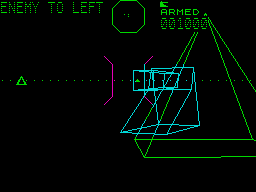
Just like the arcade original you begin the game with three lives. The game takes the viewpoint of looking outwards from the front of your tank, the battlefield complete with various landmarks and of course, enemies to evade and destroy.

The game was predominantly 'green screen' (with enemies in cyan) and used a suitable arcade style font to display current score, menu options and so on.

3D Combat Zone - Nice Battlezone Type Game As far as I know there is no end to the game, you just keep going until you run out of lives. As you destroy an enemy each subsequent bad guy is more difficult to kill than the last. Again this is matching the arcade game.

Oddball pilots his tank... There is not much else to say. For a 1983 game the 3D graphics were very impressive and it certainly wowed a lot of home gamers. The vectors move nice and smoothly and explode nicely when you score a direct hit.

If you like Battlezone and games of this ilk then you can't go far wrong and this is a great example of fine early ZX Spectrum gaming. Jon Ritman would go on to be responsible for many classic games on our favourite 8-bit machine...

We recommend getting hold of the real hardware but if not then download a ZX Spectrum emulator and download 3D Combat Zone for the ZX Spectrum. You may even be able to play it online.

It's vector-tastic.

GENRE: 3D vector graphics arcade game
RELEASE DATE: 1983
RELEASED BY: Artic Software
DEVELOPER(S): Jon Ritman
PRICE: £5.95 - UK

Classic Arcade Action:

Classic Games, Arcade Games and ZX Spectrum Games

4 Oct 2010

Spectrum Games - Chuckman - Classic ZX Spectrum Game

ZX Spectrum Chuckman
Another 'classic' game from the slightly odd software house, Custom Cables International (who were also responsible for the unofficial Star Wars computer game 3D Star Wars.

I remember picking this maze like arcade game up for my ZX Spectrum when it was re-released by Mastertronic at £1.99.

I tell you what, for £1.99 it wasn't bad.

It's hard to get into and fast moving, but if you persevere with it a good (if slightly basic) little arcade game is hidden away in there...

Chuckman ZX SpectrumThe aim of the game is pretty simple: guide your hero around a maze along the yellow paths to diffuse the numerous time bombs. So finding the bombs is your first problem, but as usual there are plenty of pitfalls to hinder your progress

From time to time there are earthquakes (eh?) which leave a nice gaping hole in the path - which will kill you if you fall in. These have to be repaired or if you can find a way you can 'go around' them.

There are also stomping boots wandering about the maze which are out to... stomp you. Avoid these at all costs as instant death occurs if you touch them. The mazes were usually quite fiendish too so there were plenty of dead-ends to leave you able to see the bomb, but not reach it. A puzzle game to make you a little tetchy.

Chuckman negotiates the maze on the Speccy...In a neat touch the mazes are generated randomly each time the game is started, so that no two games are ever the same. Pretty cool.

Dotted around the maze are wheelbarrows (to fill in any holes), toolkits (to diffuse the bombs - do not touch a bomb without carrying one of these!), rollerskates (which scare away the stomping boots - weird!) and food (to top up your energy levels).

As you move around the maze your energy slowly decreases, and firing up the map drains it even quicker. Eating food along the way is essential as when your energy level hits zero your wee guy is kaputski.

The scrolling is quite smooth and the game cracks along at a fair old pace. Once you get the hang of it the simplicity of it means a fair amount of fun as you try and find the next bomb before it explodes. There are also the usual skill levels and high score table - and a huge scrolling message every time you lose the game, which is a little bizarre. Not bad overall and a fun puzzle game.

The test of time:
It's simple, but it is pure puzzle and arcade action. The graphics are very simple (and were back in the day), but the scrolling works well, the action is fast and the controls are responsive. Oh, and try leaving chuckman alone for a little while and watch what he does - another little neat touch.

We recommend getting hold of the real Sinclair hardware but if not then download this one for a ZX Spectrum emulator. Alternatively you could try and play it online.

Please see our other ZX Spectrum retro game reviews and programmer interviews - all links are listed in alphabetical order. Cheers guys.

GENRE: Arcade Game / Puzzle Game
RELEASE DATE: 1983
RELEASED BY: Customer Cables International then re-released by Mastertronic
DEVELOPER(S): K Baker
PRICE: £5.00 then £1.99 on re-release

Classic scrolling arcade action:

Classic Games, Arcade Games and ZX Spectrum Games

15 Feb 2010

Spectrum Games - Chronos - ZX Spectrum retro game - arcade game

Chronos ZX Spectrum
This game was a budget £1.99 release for the ZX Spectrum by Mastertronic in 1987.

In this solid enough scrolling arcade game you had to resuce poor old Chronos (the lord of time no less) who had been imprisoned in another dimension by the Dimension Weavers. The poor bugger.

For a budget game it was actually pretty decent and it also featured some fantastic beeper music.

ZX Spectrum Chronos
You had to fly you craft (which looked like the craft from Ultimate's Cyberun!) across the left to right scrolling landscape blasting away at plenty of nasties, many of which were not the sharpest of bad guys. Watch them blindly fly into varying parts of the landscape - saving you the bother of shooting them.

Your ship could move up, down, left, right and of course was equipped with a forward firing lazer.

There were six levels in total (signified by the changing colour of the graphics as you progressed) and in true classic arcade fashion the game became more difficult the further you progressed.

The game went for the monochromatic look (which was probably a good choice) and had two layers of scrolling, which was smooth enough to make the game playable.

Killing everything in sight There were plenty of different enemies to avoid or destroy such as fighters, ying-yang type floating things, orbs and so on.

There were also laser barriers which had to be destroyed (by shooting the top or bottom part of them) and blastable blocks which had to be cleared away with trusty trigger finger action.

This game does sort of remind me of the classic arcade game Scramble with the maze like levels and constant scrolling.

The game was 'completed' once you breached level 6 and Chronos was rescued - no doubt just in the nick of time.

On release:
Well Chronos was a decent enough arcade game and for £1.99 was value for money. It picked up a bit of a cult status due to the impressive synthesiser style menu music and humorous high score table which would answer you with witty responses should you enter 'naughty words' instead of your name. There were also numerous Chronos cheat codes which could be activated through the high score table too - try typing in Peter Gough for starters.

The test of erm... time
Well it's a simle shooter that is still fairly playable - there are plenty of worse arcade games for the ZX Spectrum. Easy to pick up and play - give it a go to remember that Spectrum budget games could be decent.

Jing it baby!

Download a Spectrum Emulator and download this classic game for the ZX Spectrum. Alternatively you could try and play it online.

Tim Follin's impressive menu music:


GENRE: Arcade game
RELEASE DATE: 1987
RELEASED BY: Mastertronic
DEVELOPER(S): Steven Tatlock, John Tatloc, Tim Follin
PRICE: £1.99 - UK

Onto level 2 in Chronos - classic arcade game action...


Arcade Games, Classic Games and ZX Spectrum Games

16 Dec 2009

Spectrum Games - Cabal- ZX Spectrum retro game

Spectrum Games Cabal Cabal ZX Spectrum
Cabal was released on the ZX Spectrum by Ocean Software in 1989 - in time for the Christmas rush in the UK.

I must admit that this classic arcade game is one that slipped my by twenty odd years ago -but on playing today it I realised tha I missed out on a good and playable shoot em up. Once again Cabal turned out to be a good conversion of an arcade original.

The game did have a back story which went along the lines of:
A foreign country was causing a bit of aggro 'somewhere'. To avert a full-scale war our lad is sent in to dish out machine gun led justice and destroy the enemy on their own turf.

In the usual arcade game style, you were armed with a gun which was supplied with unlimited ammunition plus a limited supply of grenades. Grenades could be used to destroy tanks, helicopters, walls and groups of troops (always satisfying!), whilst the standard machine gun mowed down the enemy soldiers very nicely indeed.

You had to fight your way through twenty single screen levels. Our hero could move to the left and right across screen, whilst the gun and grenades were aimed with a cursor gun sight. Blasting larger targets occasionally awarded icons which when collected bestowed bonus points or a nice weapons powerup. If you were killed your powerup was lost though.

Cabal on the ZX Spectrum
With each enemy on the current level killed a bar at the bottom of the screen slowly crept from left to right, changing from blue to red. Once it had reached the right hand side you had completed the current level and moved on to the next.

Each screen was different from the last, and usually had a 'war torn' feel to it. There was usually a half demolished wall or walls that offered you some protection from enemy fire, and tanks and soldiers would appear from behind bombed out buildings which were 'further away' from your viewpoint.

The game was completed once all twenty levels had been conquered - and the enemy were sent packing with their tails between their legs.

On Release:
Pure arcade games like Operation Wolf and Operation Thunderbolt were still really popular in 1989 - and this game was certainly of that type of shoot em up. Although released late in 1989 games like Cabal proved that the humble Spectrum still had plenty of life left in it and wasn't quite ready to lay down for the likes of the Commodore Amiga just yet. Cabal was well received (grabbing the coveted Crash Smash award) and was yet another big hit for Ocean.

The test of time:
Well here in Spectrum Games we only just played Cabal for the first time (how I missed it back then is anyones guess!) The game is pure blasting simple fun and plays well and is pretty addictive. It took a few goes to get the hang of it - and it's a good way to pass a spare half hour. It doesn't seem to suffer from any busy screen 'slow down' either which did occur in Op Wolf (a little). Got to say I love the title music and menu too - very funky and nice to look at!

We recommend getting hold of the real Sinclair hardware but if not then download Cabal for a ZX Spectrum emulator. Alternatively you could try and play it online.

Try a three way gaming marathon with Op Wolf, Commando and Cabal.

Please see our other ZX Spectrum retro game reviews and programmer interviews - all links are listed in alphabetical order. Cheers guys.

GENRE: Arcade game
RELEASE DATE: End of 1989
RELEASED BY: Ocean
DEVELOPER(S): Jim Bagley, Keith Tinman and Charles Davies
PRICE: £8.99 Cassette or £14.99 Disk - UK

I have a go but realise I'm not very good at Cabal - Spectrum Games:


Classic Games and Arcade Games

12 Oct 2009

ZX Spectrum Games - Cavern Fighter - ZX Spectrum retro game

Cavern Fighter ZX Spectrum
Good old Scramble!
The classic arcade game by Konami was given the ZX Spectrum treatment by Bug Byte in 1984.

Even by 1984 Scramble was getting on a bit (we're talking real old school here), but Bug Byte did well with their version.

Cavern fighter was a quite classic version complete with caves, missiles, cities, fuel dumps (for you to destroy to gain fuel and points), defence installations, asteroids and alien fighters.

The object of the game was to penetrate as deep as possible into the caverns of Zragg (great name!) and destroy the evil Dictator’s lair whilst avoiding the automatic missiles, guardians and alien fighters. It was classic arcade action all the way!

All of this had to be accomplished without crashing into the zig-zagging walls and ceiling's of the caverns.

Cavern Fighter ZX SpectrumFor anyone that doesn't know in the game you could move up and down as well as left and right. You could fire horizontally (lazers) and also drop bombs onto targets.

Your fuel level constantly dropped as you flew along the right to left scrolling landscape (you never 'stopped' in this game) and you had to destroy fuel dumps to keep your fuel level topped up.

One difference that this game had over traditional scramble was that you were always 'inside' a cavern - there was always a ceiling to be wary of as well as the ground.

You began the game with three lives and the game was over if you lost them all - or you managed to kick the evil dictators butt clean across the cosmos.

On Release:
Well Scramble was incredibly popular in the arcades - and it was good to have a well crafted conversion on the ZX Spectrum. The game was playable and full of colour - the likes of Crash magazine awared it Game of the Month in April of 1984. Fans of the arcade game picked it up and were generally impressed.

The test of time:
Well Cavern Fighter is incredibly dated - the graphical style gives it away as an earlier Spectrum games release. But even so, it's still fun to play. The scrolling is adequate, the controls are responsive and it takes a fair bit of skill to make it through the varying sectors. If you're a fan of Scramble you could do a lot worse. Not bad and definately worth a go.

The games author never developed another title on the Spectrum as far as we know which is a shame as he was obviously a good coder.

Scramble! Scramble! - and play Cavern Fighter again.

We recommend getting hold of the real hardware - but if not then download a ZX Spectrum emulator and download Cavern Fighter for the ZX Spectrum. Alternatively you could try and play it online.

GENRE: Scrolling arcade game
RELEASE DATE: 1984
RELEASED BY: Bug Byte Software
DEVELOPER(S): John K Jameson
PRICE: £5.95 - UK

Sector one is no match for flying ace Major Lawrence Bartle Frere. Classic arcade action:


Classic Games, Arcade Games and ZX Spectrum Games

26 Sept 2009

Spectrum Games - Cobra - ZX Spectrum retro game

ZX Spectrum Cobra
Another classic scrolling arcade game programmed by Joffa Smith (who also coded Green Beret) and released by Ocean Software.

This game came out towards the end of 1986 and was 'loosly' based on the Sly Stallone movie.

When I say loosely I do mean loosely, Cobra was a scrolling 'kill everything in sight' arcade game that emphasised cartoony violence and humour.


ZX Spectrum Cobra
For a start when you defined your keys the menu said 'Push Me' in reference to Sly himslef and the shoot key was labelled as 'murder'. Funny stuff.

Anyway, the aim of the game was to rescue a model called Ingrid Knutsen from the clutches of the Night Slasher and his evil henchmen and hench-women.

Cobra was a scrolling arcade game (with super smooth parallax scrolling, perhaps the best generated on a ZX Spectrum) and you ran either left or right. The bad guys would run in from both sides of the screen and attempt to kill you.

To begin with our Cobra had no weapon and you had to defend him with his bonce, by head-butting everyone with such force that they were sent hurtling across the screen.

Choosing controls was even funny in Cobra - ZX Spectrum
Weapons were hidden inside hamburgers (yep!) and you could pick up either a knife, a pistol or the rather cool lazer sighted machine gun (made famous in the movie). These powerups only lasted for a certain amount of time though - represented by the slowly vanishing rubber duck at the bottom of the screen!

Cobra was a tough guy and dealing with knife brandishing thugs and rocket-launching evil women didn't scare him in the least. However, the mere sight of a pram hurtling towards him made the poor guy go weak at the knees and he was momentarily stunned if you didn't avoid the pram. Why pram's were hurlting around the screen is anyones guess!

You had three lives to begin (represented by 'Rocky' style boxing gloves) with and contact with any bad guys (or the knives they threw, rockets launched etc) took one away - unless you were toting a weapon in which case you lost the weapon and went back to headbutt mode.

Even when it was game over (or game under) it did make you laugh as you entered your name in 'The Morgue'.

Put your name in the morgue on Cobra - ZX Spectrum
Every now and again Ingrid would show up and run alongside you. This made you survive 'one hit' from a nasty. Instead of losing a life Ingrid would merely run away and would not appear again for a while.

To complete the level you had to dispose of every bad guy and use up every hamburger powerup. Once done you would move to the next level. There were three in all, but I've never made it past level two!

I finally made it off level one! On Release:
Well the movie of the same name had been pretty popular, and the game turned out to be to. It was well recieved with gamers enjoying the parallax scrolling, excellent tunes and the funny stuff. Magazines such as Crash raved about the game and it was a deserved big hit. It was always nice for a movie tie-in to be worthy and not a quick cash-in.

The test of time:
Well here in Spectrum Games we like a bit of Cobra. It is still playable and good for a laugh. The parallax scrolling is excellent and the graphics have the right cartoony style. It's bloody difficult though!

Give this classic game a go - the gameplay is still there but beware, it's not easy!

We recommend getting hold of the real Sinclair hardware but if not then download a ZX Spectrum emulator. Alternatively you could try and play it online.

Please see our other ZX Spectrum retro game reviews - all links are listed in alphabetical order. Cheers guys.

GENRE: Arcade game
RELEASE DATE: End of 1986
RELEASED BY: Ocean
DEVELOPER(S): Jonathan (Jof) Smith
PRICE: £7.95

The all too familiar game over ditty:


I'm sure NOT the cure in Cobra - a brilliant scrolling arcade game:


Classic Games, Arcade Games and ZX Spectrum Games
5 Aug 2009

ZX Spectrum Game - Contact Sam Cruise - ZX Spectrum retro game

ZX Spectrum Contact Sam Cruise
Contact Sam Cruise was released for the ZX Spectrum by Microsphere right at the tail end of 1986; just in time for the Christmas rush.

Contact Sam Cruise was something a bit different to most other titles, film-noir type detective games were not your run of the mill type of game on the ZX Spectrum!

The developers David S Reidy and Keith Warrington had collaborated on the excellent Skool Daze and the equally good Back to Skool previously for Microsphere, and used a similar graphical style to represent the city locations.

ZX Spectrum Games Contact Sam Cruise
Contact Sam Cruise loads up on the ZX Spectrum


Just another quiet day in the Sam Cruise detective agency... My secretary Daisy rattles away at the typewriter and the clackity clack rythm sends me into a distant day dream. It's hot today, too hot, the hazy sunlight is streaming through the venetians and the fan in here just pushes warm air around. We need rain, the hard rain, to wash away this stifling heat and....

The ringing of the phone snaps me out of my stupor, dabbing the sweat from my brow I reach over and pick up the receiver.

Some broad named Dana wants to meet me on the roof of the Hotel Royal - and that's all I got - with no other cases I got no choice. I leave the office and begin the case of 'The bali budgie'....

And so the adventure for you (Sam Cruise) began.

Already the case you were working on had a humorous title - 'The bali budgie' which was obviously a take on 'The maltese falcon'.

Sam Cruise was suitably adorned in trench-coat and trilby hat and could walk along the streets, enter buildings and interact with the environment.

Sam wanders the mean streets in Contact Sam Cruise
Contact Sam Cruise on the ZX Spectrum
As the character you could operate light switches, open and close blinds, use telephones, sabotage fuse-boxes and unlock or force open doors. On top of all this Sam was a sprightly chap and could perform rolls and somersaults which was useful to avoid sniper fire.

Sam was kitted out at the beginning with ten first aid kits (lives), a number of disguises and $50.00 cash.

The cash meter slowly and continuously falls and must be kept above $0.00 or the game is over.

Being shot by a sniper requires the use of a first aid kit, and if you used them all up then once again the game was up.

Entering buildings was really well done. You could go 'inside' the building and walk around, viewing our Sam through the windows. An icon would flash whenever you were next to an important item such as a telephone, which you could then use (you only began the game with the number to your office but gathered more numbers as clues were solved).

In some cases the police would not take kindly to you entering a building (except for number 19 which was a gangster house - they never showed up there!) and would appear on the scene to arrest you. Sabotaging the fuse box (and plunging the building into darkness) could allow you to escape.

Changing into a disguise could also fool the police, although they were wise to a lot of them and proceeded to recognise more of your disguises as the game wore on.

Being a private dick meant that you had to earn cold hard cash. Client fees was one way to earn money, and as certain pieces of the case were solved you would be given a cash advance from your mysterious client.

Luckily for you plenty of paper money was floating around the streets due to a recent bank robbery. Sam could be made to somersault onto any of these rogue bills and if you timed it right you got to keep the bill which could be a dollar or even a whopping five dollars!

It was a good way to keep the cash meter topped up anyway.

The game was over if Sam was shot more than ten times or if he was picked up by the mafia and unceremoniously hurled from the roof of a very tall building. Splat.

The city was nicely represented with a variety of buildings to wander around in. Microshpere managed to use a lot of colour in the locations whilst keeping the game easy on the eyes. Other citizens would go about the city on their daily routines, and of course some of them you would have to talk to.

Solving the case meant fame and fortune for the Sam Cruise detective agency, but 'The Bali Budgie' was never going to be easy...

On Release:
Contact Sam Cruise really was something new on the ZX Spectrum. Microsphere did make games that were a bit 'different', such as Wheelie and Skool Daze. Once again they came up with a winner with this noiresque detective adventure. Gamers enjoyed the interaction with the environment, the range of disguises you could use and simply exploring the well drawn city. The case you were on was tricky enough to keep you hooked in and the game also had plenty of atmosphere. It ended up being a big hit at the time and I always yearned for a sequel, but no further Sam Cruise adventures were ever released.

The test of time:
Here in the land of Spectrum games we reckon that you should look Contact Sam Cruise out. Of course it is dated and those once impressive graphics are very ordinary, but it was ahead of it's time regarding the gameplay. Entering buildings and being able to turn the lights on and off, use telephones, open doors and sometimes even make it onto the roof was really quite something. A classic arcade adventure game.

Grab a trilby and trenchcoat and give it a go. If you perservere with it and get the hang of somersaulting onto the stray money you'll be sucked into 'The Bali Budgie'.

We recommend getting hold of the real hardware but if not then download a ZX Spectrum emulator and download Contact Sam Cruise for the ZX Spectrum. Alternatively you could try and play it online.

GENRE: Detective arcade adventure
RELEASE DATE: End of 1986
RELEASED BY: Microshpere
DEVELOPER(S): David S Reidy and Keith Warrington
PRICE: £7.95- UK

Sam goes for a wander in Contact Sam Cruise on Spectrum Games:


Classic Games, Arcade Games and ZX Spectrum Games

6 Jul 2009

ZX Spectrum Game - Chuckie Egg- ZX Spectrum retro game

ZX Spectrum Chuckie Egg
Chuckie Egg for the ZX Spectrum is widely regarded as a cult classic platform game.

Released in early 1984 by A&F Software, Nigel Alderton (who was only 17 years old at the time) had created a game that was one of the better titles in the genre as soon as it was released.

Nigel would go on to work on other classic ZX Spectrum games over the next couple of years including the excellent arcade conversions of Commando and Ghosts n Goblins.

ZX Spectrum Chuckie Egg
In Chuckie Egg, our hero was a portly little dude sporting a big hat named Hen House Harry (you'd only get these names in the 80's eh?) You had to work your way around the game screen collecting the dozen eggs as you went whilst avoiding the roaming and agitated chickens.

All of this was done against the clock, which counted down relentlessly as you ran around the screen.

The screens were nicely designed at the time, putting many of the eggs in hard to reach places. The screens were drawn with combinations of short platforms, ladders allowing you to move up and down and elevators which you could step on to and off with good timing.

You would begin the game with five lives and you would lose one of these by touching a hen (how did hens become so deadly?) or by falling through a gap at the bottom of the screen (some platforms had gaps in them which had to be jumped across.)

ZX Spectrum Games Chuckie Egg In Game Screen
There were piles of bird-seed dotted around the screens which could be collected for bonus points. Collecting the seeds also paused the countdown timer for a few seconds - which could make all the difference to you on the more difficult levels.

A hen would also stop and eat any seed it walked over, which could be advantageous for you as the hen would stop and eat whilst you went around collecting the eggs.

Hen House Harry had the usual platform moves, go left, go right and jump. There were eight levels to play through in total all which had a caged duck at the topmost area of the screen. If you managed to complete all eight levels then the game would go back to level one, this time with the now un-caged duck chasing you as you attempted to collect the eggs. The duck could move around more freely than the hens - it was not affected by the layout of the platforms at all.

On Release:
Chuckie Egg was well received when it was released. ZX Spectrum gamers enjoyed the tricky screen layouts and the fast paced action. Each level took a fair bit of planning to play through, the design of the screens was pretty impressive. This gameplay coupled with the bright colours and nice animation ensured that Chuckie Egg was an instant hit. One drawback was the relatively high price of £7.90 - but the game went on to be a big hit nevertheless.

The test of time:
Here in the our homage to Spectrum Games we reckon that Chuckie Egg remains a platform / arcade classic. Of course it is a very simple game, but the action is still pretty fast, and you have to work out how best to beat each level. Once the duck is released things heat up a lot - I can't believe I used to be able to beat it! As far as platformers go, the later levels will scramble you. It may even make you crack up. Whilst not on the same level as Manic Miner or Tecnhician Ted, Chuckie Egg remains a cult classic platform game.

This classic ZX Spectrum game is definately worth cracking after all these years.

Give this one a go and bring it home to roost. Try not to get too egg-sited though.

We recommend getting hold of the real hardware - but if not then download a ZX Spectrum emulator and download Chuckie Egg for the ZX Spectrum. Alternatively you could try and play it online.

GENRE: Platform game (Arcade game)
RELEASE DATE: Early 1984
RELEASED BY: A&F Software
DEVELOPER(S): Nigel Alderton
PRICE: £7.90 - UK

Hen House Harry ambles around level 1 in Chuckie Egg - classic arcade action:


Classic Games, Arcade Games and ZX Spectrum Games

21 May 2009

ZX Spectrum Game - Combat Lynx - ZX Spectrum retro game

ZX Spectrum Games Combat Lynx
ZX Spectrum Combat Lynx
Our last review (Chequered Flag) was on what was the first proper driving simulation on the ZX Spectrum, and this classic game was probably the first proper helicopter style simulation on our lovable Sinclair machine.

Released in November of 1984 by Durell Software, who were already famous for games such as the simple but effective Harrier Attack, and the superb Scuba Dive. In fact, Combat Lynx was not just a helicopter sim, it was also a battle simulation, with you taking control of a Westland Lynx helicopter.

The devloper Mike Richardson really went to town here with attention to detail and accuracy. This game (and previous releases) established Durell (and Mike Richardson) as a formidable developer of all types of games for 8-bit machines.

Combat Lynx had picked up a bit of publicity prior to it's release as it certainly represented something new and different for ZX Spectrum gamers. The publicity was justified as it was awarded the badge of honour (a crash smash) in the hallowed pages of the popular Spectrum magazine, Crash.

On first loading you knew that you were in for something special, as the loading screen (a lynx helicopter hovering above a road) 'came alive'. The rotor blades started spinning and the helicopter launched a couple of rockets towards a nearby tank, destroying it. These sort of touches were pure quality.

The aim of the game was pretty simple (defend your bases against enemy air and ground attacks), but the actual playing of the game was quite complex.

Picking your skill level (there were four to choose from), would determine the amount of bases you had in total. Base 'zero' always had an endless supply of fuel and amunition, and could also instantly heal any injured ground personnel.

You would begin the game at Base 0, and would choose how to arm your trusty chopper. Weapons included strafing rockets, cannon and machine gun pods, all of which fired in the direction the helicopter was facing. There were also the excellently named HOT weapons, which were wire guided anti-tank weapons, heat seeking anti-aircraft missiles (which could be fired without the need for aiming), and finally mines which could be deposited around your base perimeters to form a nice ground defence.

You could also carry inured and uninjured troops - it was a case of balancing your weapons and fuel against the maximum load you could carry. Already the attention to detail and accuracy was apparent within the game; it would require strategy and planning as well as good reflexes.

It was now time to take off, and remember even Jan Michael Vincent would have been overawed by the playing screen at first.

The main area of the screen was the 'view' - where your combat lynx would be shown in the surrounding landscape. The bottom area displayed navigation, weapons details and any immediate threats. To the left you would see your choppers height and any message alerts.

Flying would take a while to get the hang of as you would need to rotate your lynx then move in that direction. Turning through a ninety degree angle would make the screen 'flick' and you would now be viewing the landscape from that new angle.

It was disconcerting at first, but once you got the hang of it then you could really get stuck into the game proper. Nice contour lines over the hills added to the sense of movement once you began flying. All in all you could describe it as having a sort of 'remote cockpit view'.

Anyway, now that you were armed and off, you could decide what you wanted to do. There were no hard and fast missions, and it was up to you decide what to do first. Do you want to lay mines around your base as a first line of defence? Do you want to get to another base and drop off some supplies there? The open ended nature of the game really set it apart as something special.

The balance between strategy and arcade action was excellent. Before long enemy ground forces would be taking pot shots at you and enemy jets and helicopters would fly by and some of them would attempt to blow you out of the sky.

Instant fun could be had trying to shoot down enemy aircraft or destroying enemy tanks. Different weapons were also more effective against certain targets - but the more you played the better your aim would get. Due to this the game got you into the action quickly, but once you got stuck into the game properly then the depth of it really became apparent.

You could play for hours (if you were any good!) transporting troops and supplies to your bases around the map, creating minefields and watching in satisfaction as enemy vehicles drove into them and met their doom. This type of gameplay gave the game a lot of longevity.

On Release:
This game was well received when it hit the high street. It was unique when it was released as there was nothing else close to it in terms of detail regarding helicopters and weapons. The 3D effect was convincing, and when you got your chopper up to full speed the hillsides, houses and enemy units whizzed by giving a nice sense of speed and perspective. The fact that you had to watch your engine revs, height, fuel etc appealed to those who craved some realism within their games.

The test of time:
Well we here in the land of Spectrum Games reckon that Combat Lynx has stood the test of time pretty well. It still has a degree of playability and the different enemy units and weapons you can choose provide a good challenge and varied gameplay. By todays standards it is a simple arcade/strategy game, but Combat Lynx really paved the way for further real time strategy titles. Little touches like the cross section views of your helicopter enforced the realism that had been put into the game. Raise a toast Durell and Mike Richardson folks!

So - grab your joystick, ,get some leather flying gloves and GET TO DA CHOPPAH. You'll soon be experiencing 'The Lynx effect'.

This classic arcade/strategy game for the ZX Spectrum is definately worth another look after all these years.

We recommend getting hold of the real hardware - but if not then download an emulator and download Combat Lynx for the ZX Spectrum. Alternatively you could try and play it online.

GENRE: Arcade Strategy Game
RELEASE DATE: November 1984
RELEASED BY: Durell Software
DEVELOPER(S): Mike Richardson
PRICE: £7.95 - UK

Flying ace major Lawrence Bartle Frere shows us he is all about planes in this fine classic game in Spectrum Games - Combat Lynx:

12 May 2009

ZX Spectrum Games - Chequered Flag - ZX Spectrum retro game

ZX Spectrum Chequered Flag
The first proper driving simulation on the Sinclair ZX Spectrum which pushed the quality of driving games up a significant notch. The driving simulation era was born.

Perhaps inspired by the arcade game 'Pole Position' by Namco, Chequered Flag (or Flag as it would later become known) was released in 1983 by Psion Software, who had previously been famous for releasing games such as Flight Simulation and various titles for the Sinclair ZX 81.

This game (and Flight Simulation) established them as a formidable developer of accurate simulation games that were based more on reality than arcade style action.

ZX Spectrum Games Chequered Flag
This game had been highly anticipated during the run up to it's release, as there had been no accurate driving simulations on the ZX Spectrum up until this point. A driving game that really launched the genre of driving simulation, Flag had the polish and the vroom to make it a reasonable seller.

It was awarded a good score of 71% in the hallowed pages of the popular Spectrum magazine, Crash.

The aim of the game is pretty simple: Pick your car (there were three to choose from), pick your circuit (there were ten to choose from), pick the number of laps you want to complete, and get yourself onto the starting grid.

The ten tracks were based on real life formula one tracks (such as the UK's Brands Hatch, the circuit at Monaco and so on) adding a sense of realism to the game from the off. The three cars had differing degrees of speed and handling, giving the player a broader range of challenges.

There was the crappily named 'McFaster Special' which had an automatic gearbox, low revs and was easy to handle. The mid-range car was the equally badly titled 'Psion Pegasus', and the most difficult car to master was the uber-powerful Feretti Turbo. At least it had a decent name. Anyway, onto the 'racing'.

Racing in a traditional sense was not in this game as there were no other cars to race against. The challenge was to beat the clock.

Sitting in the cockpit of your car was (at the time) quite exciting. You could see the rev counter, speedometer, fuel gauge, temp gauge and of course, the steering wheel. Looking over the nose of your car you could see your front tyres. The traffic lights would turn from red to green and you would be off.
Formula One Action in Chequered Flag
Your jaw would drop as you accellerated forward and came towards the first corner on the track. As you turned (you could even turn gently or sharply) the steering wheel of your car would actually turn too. Amazing!

Hurtling forward, you would speed your car over the tarmac, up and down hills (nicely represented by the horizon lowering and raising), and throw it around sharp bends. To make your drive more difficult, hazards such as broken glass, rocks (rocks on a race track?), water spills and oil slicks would be strewn around the circuit - and were obviously best avoided.

Running over these items could burst a tyre, damage the underbelly of the car causing fuel leaks and so on. In keeping with realism, your cars performance would be hindered by damage, and you would have to make a pit stop to get the damage repaired.

The game was over when you either completed your lap(s) or your car was too damaged to go any further. Crashing off the side of the track would instantly bring your race to an end. It was now up to you to race again and beat your lap time.

On Release:
To be fair this game was never a must have title, but it was unique when it was released as there was nothing else close to it in terms of realism. The 3D effect was convincing, and when you got your car up to full speed the roadside items did whizz by giving the player a nice sense of speed. The fact that you had to watch your engine revs and tyres sat well with formula 1 enthusiasts. The real drawback of the game that prevented it from being a true classic game was the fact that there were no other cars to race against. Otherwise it represented a solid (and realistic for the time) driving experience.

The test of time: Well we here in the land of Spectrum Games reckon that this game has stood the test of time pretty well. It still has a degree of playability and the different cars and tracks provide a stern challenge. By todays standards it is a simple driving game, but this title really paved the way for further driving simulators such as the legendary Formula 1 Grand Prix by Geoff Crammond, and games such as Jaguar XJ220. Little touches like your your final report on completing your race such as 'car in excellent condition - give your mechanics the day off' highlighted the effort to capture realism that had been put into the game. Psion have a nice classic game here.

So - catch the Formula 1 on a Sunday, stick on a bit of Radar Love, grab your leather driving gloves and give this one a go. You'll 'lap' it up.

This classic driving game for the ZX Spectrum is definately worth another look after all these years.

We recommend getting hold of the real hardware - but if not then download a Spectrum emulator and download Chequered Flag for the ZX Spectrum. Alternatively you could try and play it online.

GENRE: Driving Simulation / Arcade Game
RELEASE DATE: 1983
RELEASED BY: Psion Software
DEVELOPER(S): ?
PRICE: £6.95 - UK

The Speccy itself shows us how it's done in the classic game:

Arcade Games, Classic Games and ZX Spectrum Games

ZX Spectrum Games - Commando - ZX Spectrum retro game

ZX Spectrum Commando
Some classic gaming shooters never die, and Commando for the Speccy is one of them.
This was originally an arcade game released in 1985 by CapCom.

This vertical scrolling arcade game was converted to several home computer and console formats. The ZX Spectrum version was well recieved, recieving the coveted 'Crash Smash' award (from our favourite magazine) in December 1985.

ZX Spectrum Commando
The game involved you taking the role of a crack commando - 'Super Joe' (The 80's came up with some great character names eh?).

Your mission: To penetrate deep behind enemy lines and destroy their two main fortresses. The game takes place over a vertically scrolling landscape and you are armed with a sub machine gun and a few grenades. Okay, by todays standards the game is pretty simple, but back then it was a pretty faithfull conversion of a popular arcade game.

The vertical scrolling is nice and smooth and the landscape is pretty well drawn. The screen can get pretty busy on later levels without much of a slowdown at all - a testament to the developers Keith Burkhill (who some of you may also remember for games such as Missile Defence) and Nigel Alderton.

End of level 2 - Commando ZX Spectrum
There are some nice touches in the game such as the soldiers on bikes, running under bridges, green coloured officers, and jeeps that would sweep across the screen and take a couple of pot shots at you. It was not an easy game by any stretch (on the Speccy anyway), and the later levels with caves for the enemy to hide in and rivers to negotiate provided a hard but fair challenge.

No powerups were available save for collecting more grenades which were strewn around the landscape, which added to the difficulty and made you rely on your skill and reflexes to plough through the later levels.

The test of time:
Well we here in the land of Spectrum Games reckon this game has stood the test of time pretty well. It is still playable and challenging, and can hook you in on your first go. Even the way you put your name into the high score table is pretty cool. Overall a classic arcade game.

So don a pair of combats, get your 'cammo face' on and call Major General Franklin Kirby - cos all frikkin' hell is gonna break loose.

This fine retro shooter for the ZX Spectrum is definately one worth revisiting.

We recommend getting hold of the real hardware - but if not then download a ZX Spectrum emulator and download this game for the ZX Spectrum. Alternatively you could try and play it online.

GENRE: Arcade game (shoot em up)
RELEASE DATE: December 1985
RELEASED BY: Elite Software
DEVELOPER(S): Keith Burkhill and Nigel Alderton
PRICE: £7.95 - UK

Level one cracked - classic arcade game:


Arcade Games, Classic Games and ZX Spectrum Games

The Retro Brothers Favourite ZX Spectrum Games...

Jetpac Remake