ZX Spectrum Games

ZX Spectrum Games
Showing posts with label Games - Reviews (B title). Show all posts

24 Mar 2010

Spectrum Games - Buccaneer - ZX Spectrum classic game

ZX Spectrum Buccaneer
This scrolling arcade game was released by Firebird software for the ZX Spectrum in 1985.

In the tried and tested arcade shoot em up tradition it was a right to left horizontal scroller with waves upon waves of alien nasties to blow out of the sky.

Buccaneer ZX Spectrum
At the beginning of the game your craft can only move up and down (as well as firing) - and the waves of aliens are pretty easy to dispose of.

You also had a limited shield to protect you - but too many hits by alien missiles or collisions with alien craft would cause your poor old Buccaneer to explode.

You also had a finite supply of fuel - so you had to destroy every alien nasty to complete the level. If you delayed too long then your fuel supply would be gone along with your plane.

Some levels removed your planes missiles - so you had to weave around frantically dodging the alien menace until you reached the end of that stage. At the beginning of the next level your missiles were restored. Hooray!

Die alien scum! - Buccaneer ZX Spectrum From time to time you could also dock with a mothership/supply ship type craft. This would replenish you shields and fuel making your fight against the alien oppressors that little bit easier.
The background scrolling was decent enough, with the hills on the horizon and clouds scrolling at different screens giving a nice enough parallax effect. With a little time and polish this is one arcade game that could have realised it's potential.

On Release:
This arcade game was hampered when it was released due to it's over use of colour which resulted in the dreaded attribute clash. Some of the sprites tended to flicker too. Still, for only £1.99 it was a decent enough slice of arcade pie that kept fans of scramble happy for 20 minutes.

The test of time:
Well Buccaneer still has an element of fun but really lacks overall polish. It can become repetetive quite quickly and to be honest there are better shoot em up style games for the ZX Spectrum - even those that were budget games.

Not bad and worth a go.

We recommend getting hold of the real Sinclair ZX Spectrum hardware, but if not then download a ZX Spectrum emulator and download Buccaneer. Alternatively you could try and play it online.

Please see our other ZX Spectrum retro game reviews - all links are listed in alphabetical order. Cheers guys.

GENRE: Arcade game
RELEASE DATE: 1985
RELEASED BY: Firebird Software
DEVELOPER(S): Peter Gough
PRICE: £1.99

Check out the parallax scrolling in this lesser known arcade game...


Classic Games and Arcade Games

15 Dec 2009

Spectrum Games - Bombjack - ZX Spectrum retro game

Bomb Jack ZX Spectrum
Elite software, who won so many 'tie in' titles, created one of the best ever arcade conversions (one to rival Commando) on the ZX Spectrum with Bomb Jack in April of 1986.

Tehkan (now Tecmo) had created the popular arcade game in 1984 so a home computer conversion was always on the cards.

Spectrum Games Bombjack
In this retro arcade game you controlled Jack - a 'superhero' who could leap incredibly high and gracefully glide to the ground. He could diffuse bombs too by simply touching them - I suppose that's why he was called Bomb Jack.

Anyway - in Bombjack a load of bombs (the cartoon style black 'balls' with a fizzing lit fuze) had been placed in famous locations all around the world. I'm not sure why!

The locations were:
The Sphinx and pyramids
The Acropolis
Neuschwanstein Castle
Miami Beach
Hollywood (LA)

The object of the game was to 'diffuse' the bombs and defeat the various enemies on each screen - each screen being one of the famous locations.

Each of the screens usually had platforms on it too - you couldn't jump through these platforms but you could land on them and walk over them if you wanted to.

Various baddies populated each screen such as robots, birds and deadly snails (yep, deadly snails!) which would take one of your three lives on contact with you. You had to manouver Bombjack around these nasties by leaping and 'floating' around the screen, you could also change direction in mid-air which was pretty cool.

Bombjack on the ZX SpectrumOnce you had collected/diffused your first bomb (they never exploded, no matter how long you let them fizzle!) another one's fuse would ignite. You could collect all the bombs in the order that the fuses beacame lit - but it didn't really matter if you didn't bother. If you did collect them all in order a bonus was put your way. Collecting all twenty three bombs in the active state resulted in a whopping 60,000 bonus points.

Either way - once all the bombs on screen had been collected, Bombjack moved on to the next screen

Every so often a disk bearing the letter P arrived - collecting this immobilised the enemies and turned them into stationary smiling faces (for a few seconds - Pac Man style)which could be collected for yet more points.

An E disk added an extra life, while a B disk added points and increased the value of any subsequent bombs collected. Nice.

Once you had visited all of the screens you were whisked back to the beginning - with the platform layout altered and the nasties even nastier.

On release:
Well the arcade game of Bombjack had been relatively popular down yer local arcade - and the style of gameplay was ripe for a conversion. Andy Williams and Paul Holmes really did the original justice and Bombjack was a top version. Spectrum gamers loved the game and it was a huge and deserved hit.

The test of time:
Well you know what, I've played 1000's of Spectrum Games and this is one I come back to now and again. The gameplay is sooo simple yet still pure. It doesn't rely on flashy graphics or even immersive music to draw you in. Bombjack on the Speccy is still hugely playable and fun - a true arcade classic.

You've got to play Bombjack and appreciate it - it's da bomb!

We recommend getting hold of the real Sinclair ZX Spectrum hardware, but if not then download a ZX Spectrum emulator and download Bomb Jack. Alternatively you could try and play it online.

Please see our other ZX Spectrum retro game reviews - all links are listed in alphabetical order. Cheers guys.

GENRE: Arcade game
RELEASE DATE: April 1986
RELEASED BY: Elite Software
DEVELOPER(S): Paul Holmes and Andy Williams
PRICE: £7.95

The colourful menu screen in Bombjack:


Our hero clears the first two screens in Bombjack - Spectrum Games:


Classic Games and Arcade Games

2 Dec 2009

Spectrum Games - Bobby Bearing - ZX Spectrum retro game

ZX Spectrum Bobby Bearing
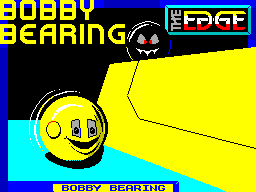
Ball and marble games were all the rage for a while (look at the arcade classic Marble Madness) and Bobby Bearing by The Edge was a pretty cool game.

It was released in the summer of 1986 for the ZX Spectrum and turned out to be a pretty big hit - and as clones of 'marble madness' go this one wasn't bad.

ZX Spectrum Games Bobby Bearing
The inevitable back story to Bobby Bearing went along the lines of...

Bobby’s family lived in Technofear - a land of the future made from steel and inhabitated by things of steel. Bobby and his brothers had been warned on many occasions not to venture into the Metaplanes outside their home, and generally they had been pretty good about it. One day their maverick cousin paid them all a visit - and he led them on an adventure into the metaplanes...

Now Bobby had to venture into the dangerous metaplanes and rescue his brothers (one at a time) from the evil beings that lived there. Once the four brothers had been brought back to safe haven the cousin could be rescued (not that he deserved it!)

This classic game boasted a neat graphical engine called 'Curvispace 3D' - which allowed the games characters (Bearings) to actually roll over uneven surfaces with realistic physics.

It was a case of solving puzzles and routes, some easy, some fiendish, some almost impossible.

Bobby Bearing ZX Spectrum
You began the game outside your 'home' - and your brother bearings had to be brought back here. As you travelled around the large flick screen playing area (arcade adventure style) you would come across magnets which could be switched on and off, areas of the surfaces with hidden switches and air ducts. Some hidden switches activated lifts and platforms etc.

This puzzle game was played against the clock which would increase in countdown speed as you hit various obstacles. Apart from the evil bearings you also had to watch out for slabs of concrete which would crash down on top of you and descending blocks sent our Bobby into a spin.

Falling off a ledge also caused the countdown clock to speed up - the game could be frustrating (but in a good way).

On release:
This arcade puzzle game was compared to the likes of Spindizzy and Marble Madness (as you would expect) when it was released in the summer of 1986. Gamers enjoyed the ballbearing physics, puzzles and locations to explore. For anyone who liked games of this ilk, Bobby was an essential purchase.

The test of time:
Well it's a little dated but it's still not bad! As the game never relied on graphics or fancy garnish - it's still got a decent amount of playability. As far as this type of game goes, Bobby Bearing was one of the best on the Spectrum. Nice scrolling message whilst loading too.

Give it a go. Patience is worth it in this game.

We recommend getting hold of the real Sinclair ZX Spectrum hardware, but if not then download a ZX Spectrum emulator and download Bobby Bearing. Alternatively you could try and play it online.

Please see our other ZX Spectrum retro game reviews - all links are listed in alphabetical order. Cheers guys.

GENRE: Arcade puzzle game
RELEASE DATE: August of 1986
RELEASED BY: The Edge
DEVELOPER(S): Robert and Trevor Figgins
PRICE: £7.95

Bobby gets his Bearings in a classic arcade game:


Classic Games and Arcade Games

30 Jul 2009

ZX Spectrum Game - Brian Bloodaxe - ZX Spectrum retro game

ZX Spectrum Brian Bloodaxe
Brian Bloodaxe was released for the ZX Spectrum early in 1985 by The Edge who had already gained success with games such as Starbike and Psytraxx.

Brian Bloodaxe is a notable ZX Spectrum classic game due to it's back story and off-beat humour.


ZX Spectrum Brian Bloodaxe
Anyway, the whole story of this platform game was that he had been frozen in an ice block for hundreds of years - sounds like the big freeze of 2009! Anyway, being that he was a Viking king, he decides to continue where he left off: conquering Great Britain!

The game had around 100 screens of platform action to play through - and to win you had to steal the crown jewels and get our Brian seated on the throne.

In usual platform style you could move left and right and jump, allowing our 'hero' to move around the screens by jumping over enemies, gaps in the floor and so on.

Although Brian had to evade most of the games surreal and bizarre enemies (such as the famous Daleks from Doctor Who!), it was possible to kill some of them by headbutting - which would stab them with the horns of his helmet.

There were also a few items to collect which would help you in your quest (such as keys and tankards of beer) - but the emphasis of this platform game was on evading the nasties and exploration.

ZX Spectrum Games Brian Bloodaxe - note the DalekOn load up you knew you were in for something a little different. The 'liberty bell march' was the title tune and as you started the game - well let's say the first time I ever played Brian Bloodaxe it fooled me for a second. I never 'blew' on the keyboard though.... honest!

This game is probably not as well remembered as other platform or arcade games on the ZX Spectrum, but it was pretty well received when it came out. Other platformers such as Manic Miner, Technician Ted, Dynamite Dan and Jet Set Willy became the kings of the genre - Brian Bloodaxe is more of a cult title.

On Release:
Brian Bloodaxe was well recieved when it was released for the ZX Spectrum and many enjoyed the slightly wacky humour within the game. Unfortunately it came out in the midst of other platform games, and it lacked the overall polish of a lot of these other titles. It was a decent enough game at the time and for anyone that was into platform games it was definately worth getting hold of.

The test of time:
Me and my fellow geek reckon that in the grand scheme of Spectrum Games Brian Bloodaxe has not aged at all well. The graphics are pretty basic and overall the game does lack a bit of polish. Mind you, it did make us laugh - the opening of it is still funny. Worth a look for nostalgia and for anyone that missed it first time around.

It should be noted that this game is currently being remade (it must have a cult following) - check out http://mremakes.free.fr/ for more information.

We recommend getting hold of the real hardware but if not then download a ZX Spectrum emulator and download Brian Bloodaxe for the ZX Spectrum. Alternatively you could try and play it online.

GENRE: Platform game (Arcade Game)
RELEASE DATE: Early 1985
RELEASED BY: The Edge
DEVELOPER(S): Charles Bystram
PRICE: £7.95 - UK

The humourus opening to a lesser known yet classic game:

Arcade Games, Classic Games and ZX Spectrum Games

26 Jun 2009

ZX Spectrum Game - Bounder - ZX Spectrum retro game

ZX Spectrum Bounder
In the mid-eighties, ball based arcade games (such as Marble Madness and Trailblazer) were all the rage on 8-Bit machines - and Bounder was another good ball based game.

Gremlin Graphics released bounder for the ZX Spectrum in the summer of 1986 - and it was well liked by those classy Spectrum gamers.

ZX Spectrum Games Bounder
Bounder could probably be regarded as a platform game with a difference: the game was viewed from a top down angle, or birds-eye view. The whole idea of the game was to guide the ball (which was a tennis ball) through varying screens of obstacles whilst it bounced along.

Our bounder had to negotiate a pathway of hexagonal paving stones that continuously scrolled down the screen.

This game contained a whopping 174 screens which were split into ten levels meaning you really had a tough task in completing the game. The general rule was to avoid anything that moved and to bounce only on the hexagonal parts of the screen. Sounds easy you say?

Well, Bounder was pretty tricky due to the nasties put between you and the end of the levels. Obstacles to avoid included piles of jagged rocks, stone walls (which had to be bounced around), and shards of broken glass which punctured your tennis ball if you bounced onto them.

Apart from the rocks, glass and walls, a range of nasties roamed the playing area intent on bursting your little tennis ball. The excellently named Binoculoids zoomed around trying to knock your ball off course, Moscita birds swooped down on top of you and Stickits, Exocet missiles and Chomper Domes (truly superb named baddies!) tried to stop you in their own way.

A stock of seven tennis balls Was given to the player at the start of the game and a life was lost every time you strayed off the yellow pathway or collided with any of the nasties. There was some help in Bounder though - as was usual with classic arcade games some powerups were available.

Landing on a square with an arrow in it supercharged the next bounce allowing you to hang in the air for twice as long as a normal bound. Teleport areas warped the ball to the next teleport square which could allow you to avoid any nasties lurking in between. Some squares were marked with a question mark and these squares concealed a surprise. Landing on one revealed a random powerup, which could be something nice like an extra life, or something not so nice!

Once you reached the end of a level your tennis ball was shot through a goalmouth and you were taken to the bonus screen. The screen was full of 'mystery squares' and each one held a random number of bonus points. A bounceometer in the status area of the screen told you how many bounces were available to you to use on the bonus screen - so using your bounces wisely was the way to gather maximum points. You could claim yet a further bonus (it's starting to sound like a game show!) by landing on all of the bonus squares on the screen.

The game was always moving (as in the ball always bounced on it's own), increasing and decreasing in size as it bounced in relation to the ground. You HAD to control the ball as it always bounced forwards - the real trick to the game was keeping it 'alive'. Once you got the hang of it, addictive was the word.

On release:
When Bounder was released for the ZX Spectrum it was praised for it's original concept and gameplay. It was a definate nice twist on the platform genre, and the simple concept combined with the smooth scrolling levels and imaginative enemies marked it as a game with a difference. Bounder was a big hit and plenty of gamers picked it up. Tennis balls were only more popular when Wimbledon was on!

The test of time:
Your humble reviewer here in the land of Spectrum Games reckons that Bounder is a bit of a cult classic. Make no mistake, Bounder is no pushover (although my reflexes are probably not as sharp as they used to be!), but it's a fun little game. It needs a few goes at it to get the hang of the gameplay, but once you do, there is a good game in there. Gremlin rarely released a dud, and Bounder was another quality title from a quality software house.

Please give Bounder a go and perservere with it, it's a good little retro game.

We recommend getting hold of the real hardware but if not then download a ZX Spectrum emulator and download Bounder for the ZX Spectrum. Alternatively you could try and play it online.

GENRE: Top down platform game (arcade game)
RELEASE DATE: Summer of 1986
RELEASED BY: Gremlin Graphics
DEVELOPER(S): Sean Hollingworth, Marcos Druroe, Peter Harrap and Chris Kerry
PRICE: £7.95 - UK

Mart makes a balls up in Bounder - a classic arcade game:

Arcade Games, Classic Games and ZX Spectrum Games

15 Jun 2009

ZX Spectrum Game - Barbarian - ZX Spectrum retro game

ZX Spectrum Barbarian
We have already had one classic beat em up on the ZX Spectrum from Melbourne House in Way of the Exploding Fist - so let us discuss another good fighting game from another company (Palace software), Barbarian.

This arcade game was well received when it was released due to it's gameplay, nicely animated graphics and the fact that you were fighting with swords rather than feet and fists. This game really built on past succesfull beat em ups such as Exploding Fist and Yie Ar Kung Fu.

Barbarian ZX Spectrum

Palace software released Barbarian in 1987 and it notched up a high score in Crash magazine, earning an overall of 85% which was a very good score. The game was an instant hit, and the versions for the ZX Spectrum and Commodore 64 sold really well.

Barbarian is set in a land of mythical creatures, warriors, wizards and warlocks, which made this classic fighting game a bit different from most other offerings in this mould.

In a slight twist in the beat em up genre, there is a backstory to go with the game. An evil sorcerer who goes by the name of Drax (sounds like a carpet cleaner) has a fancy for a rather tasty princess called Mariana. If she is not delivered to him then he will unleash his powers on the Jewelled City - which will probably mean not the best of times for the local townsfolk.

As a compromise, he agrees to let the champion swordsman of the city (a strange Barbarian, who saunters in from the northern wastelands) to compete against his own band of fighters. That Barbarian is you - and it is time for the tournament to commence.

The aim of the game is to defeat Drax's series of opponents in one on one battles of swordplay. As you would expect, each opponent is a better fighter than the last, with greater intelligence and better reactions to your attacks.

Both fighters would start the game with a full amount of energy which would be depleted by the landing of succesfull blows. To win the bout you would have to completely deplete your opponents energy. There were plenty of moves you could perform as the Barbarian (16 in total) which allowed for a good variety of attacks and evasive manouvers.

It was possible to swing your sword and aim for a high blow to the head, mid level blows, crouching chops to the opponents legs, hacking actions into the top of your opponents skull and so on. You could even kick out at them with your leg and cause damage this way.

Everybodys favourity move had to be the full 360 degree turn slash. Your barbarian would spin completely around and swing his sword at your opponents neck level causing alot of damage to your opponent. If you caught him just right, then his head would be chopped off and the bout was instantly over in your favour.

This was a nice touch to the game and was great fun. I don't know about you, but this method of win by decapitation was always good for a laugh - except when it happened to you.

Whenever your opponent was defeated a small lizard like creature would wander across across the screen and drag the corpse away whilst booting the decapitated head like a football - another good touch.

There were four stages to fight through (with four bouts per stage I think), with the background you would fight in changing in each stage. If you were handy enough and fought your way through all opponents then you would face off against Drax in the final battle, who would resort to cowardly fighting and use magic to engage you in combat.

He would hurl fireballs at you from a distance and generally be a chicken. It took a bit of skill to move in close and hack the crap out of him. Anyway, if you finished old Drax off then you would win the day, and also the delectable princess. Nice.

All fights were enjoyable, the characters were well drawn and animated and moved nice and smoothly through their moves - the animation was good back in 1987. The only real let down of Barbarian was the final fight with Drax, which was probably the least enjoyable part of the game.

Still, the playablity of the game (things like rolling into your opponents legs, then booting him in the face as he gets up), the nicely drawn characters, the mythical setting and little touches like decapitations and the snake graphics up each side of the screen marked this as a worthy game to buy. The two player option was good fun too, slicing and dicing your best mate over a Speccy keyboard was always good for a laugh, and added further longevity to the game.


Barbarian Cover - ZX Spectrum


On Release:
Barbarian for the ZX Spectrum was actually popular before it was released. This was due to some 'outrage' at the scantily clad princess on the front cover of the cassette (played by glamour model Maria Whittaker) - many deemed it not suitable for a computer game. The furore surrounding the game ensured its success before it was even released - but it was a great fighting game and any success it gained was well deserved. It was quite steep retailling at £9.99, but most folk did not mind paying a little extra for a quality beat em up. Incidentely The Barbarian on the cassette cover was played by Michael Van Wijk who went on to play everyones favourite villain 'Wolf' in the TV programme Gladiators (UK).

The test of time:
Well we here in the land of Spectrum Games reckon that Barbarian has a good amount of retro appeal. The playabilty is still there, the computer offers you a decent challenge. It is far superior to later awful offerings such as Rise of the Robots. The two player option is still great fun for you and a friend - a classic beat em up game.

So stick on a bit of Conan, flex yer pecks and give this one a go, you'll enjoy it.

This fine beat em up for the ZX Spectrum is definately worth another look after all these years.

We recommend getting hold of the real hardware - but if not then download a ZX Spectrum emulator and download Barbarian for the ZX Spectrum. Alternatively you could try and play it online.

GENRE: Beat em up (arcade game)
RELEASE DATE: 1987
RELEASED BY: Palace Software
DEVELOPER(S): Steve Brown and Shaun Griffiths
PRICE: £9.99 - UK

One of Drax's henchment meets cold steel in this classic arcade game:


Arcade Games, Classic Games and ZX Spectrum Games

29 May 2009

ZX Spectrum Game - Bruce Lee - ZX Spectrum retro game

ZX Spectrum Bruce Lee
Bruce Lee was published for the ZX Spectrum by US Gold and produced by Ocean Software. It was released in May of 1985 and met with a lot of praise due to it's nice mix of platform, beat em up and classic arcade action.

Both US Gold and Ocean already had good reputations within the Spectrum's games market, and Bruce Lee enhanced those reputions further.


ZX Spectrum game Bruce Lee
The premise of the arcade game was that you (as the legendary Bruce Lee) had returned to the land of your forefathers to destroy a wicked wizard. Succeeding in this would reward you with vast of amounts of treasure whilst obviously freeing the land of the evil control of the wizard.

Starting on the surface, you had to locate the secret entrance that would grant you access to the wizards underground lair. The whole game was based around collecting lanterns from the various locations - the game was of the 'flick screen' platform variety. Collecting lanterns would open up walls, doors, secret passages and so on - so collecting them was essential to progress through the screens.

Bruce could move pretty well around the screens, running left or right and jumping. You could also climb up and down certain parts of the scenery (such as ladders) and could also execute powerful punches and flying kicks. You would need to use all of these moves on a lot of the screens.

Two enemies in this classic game harrased our Bruce constantly, the 'Green Yamo' (even though he was white and not green) and the Ninja. These guys could be despatched with relative ease by repeated flying kicks or punches, but in true South Park Kenny style would reappear almost as quicky as you had taken them out.

Bruce Lee ZX Spectrum It was not only the enemies that could kill you in the game, you also had to avoid large daggers, exploding plants (?) and electric charges which added more to the game than just jumping and brawling.

To complete the game you had to fight your way through all of the screens (20 I think in total), collecting the lanterns and hit a switch to kill the wizard. After that it was back to the start to do it all again. I always wanted to fight the wizard in true enter the dragon hall of mirrors style - but maybe that's just me.

One excellent feature of the game was that the game allowed the player to compete against either the computer or other human players. Apart from the first option of playing against the computer a second option allowed an opponent to assume the role of the Green Yamo. Alternatively a third option allows two players to take turns at being Bruce, against the computer or with a third opponent as Yamo.

This nice little mix and match of characters added longevity to the game.

On Release:
Bruce Lee on the ZX Spectrum was well received when it was released, collecting a score of 91% in Crash magazine. Gamers enjoyed the frenetic action, the mixture of platform puzzle and beat em up and the colourful backgrounds. This one was fun to play, easy to get into and was interesting when your friends played as the Green Yamo.

The test of time:
Well we here in the land of Spectrum games reckon that this easy yet classic game is worth another look. It is very simple, but running and jumping across the platforms and collecting the lanterns still holds some appeal. Doling out a good kicking to the two enemies is good for a laugh too. Easy to play, Bruce Lee is a good way to fill a spare 20 minutes. Not a bad little retro game at all.

We recommend getting hold of the real hardware but if not then download a ZX Spectrum emulator and download Bruce Lee for the ZX Spectrum. Alternatively you could try and play it online. Chop chop!

GENRE: Beat em up arcade game
RELEASE DATE: May of1985
RELEASED BY: Ocean Software (Released by US Gold)
DEVELOPER(S): Ron Fortier and Kelly Day
PRICE: £7.95 - UK

Bruce gains access to the evil wizards underground lair in Spectrum Games:

Classic Games, Arcade Games and ZX Spectrum Games

10 May 2009

ZX Spectrum Games - Beach Head - ZX Spectrum retro game

ZX Spectrum Beach Head
We have another classic game from US Gold in Raid Over Moscow - so let us discuss another good ZX Spectrum game from the same company, Beach Head

This title was well received when it was released due to it's varied gameplay, 3D graphics and constant arcade action. This game really put US Gold on the map as a good developer of games in the 8-Bit arena, and for the ZX Spectrum.

ZX Spectrum Beach Head
Beach Head was released for the ZX Spectrum in 1984 by US Gold. Beach Head was an instant hit, and the versions for the ZX Spectrum and Commodore 64 sold really well.

The aim of the game is to defeat an enemy fleet in airborne, seaborne and landborne battles. After selecting your difficulty level and control choice, you would input your name and now be the 'commander' of the fleet. A map would appear showing two main areas of engagement.

You could choose to meet the fleet head on or you could choose to negotiate through a narrow canal which contained many mines as obstacles. Negotiating this canal succesfully would make the enemy fleet forces lighter when you would later engage them. The game could really be broken into five stages which were:

Canal Minefield Run:
You would have to take ten boats and sail them through a canal area, avoiding mines and torpedoes and ensure that each boat made it succesfully to the exit area of the water. This stage was optional, but if you completed it then the forces you would meet in the next stage would be lighter.

Defending your fleet against airborne bombardment:
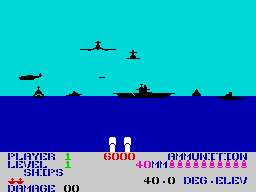
You would be now be controlling an anti-aircraft gun which could be moved from side to side and the elevation could be increased or decreased. You would see the enemy fleet in the distance, with their aircraft carrier being the most prominent ship. Planes would launch from the carrier and would approach you, starting as small specks in the distance and becoming larger as they would swoop overhead and drop bombs on your ship.
Beach Head ZX Spectrum
The 3D effect for this was (at the time) quite something. It would be up to you to shoot down these planes (10 if you had moved your fleet through the canal, 30 if you had engaged the enemy fleet head on if my memory serves me correctly). The anti-aircraft guns under your control had a nice recoil action as you unleashed your ammo at the enemy planes.

Hitting a plane would cause it to explode instantly - and shooting it out of the sky before it had dropped it's payload of bombs was the way to do it. If too many bombs hit then your fleet would lose a ship. If you were a really poor shot then all of your ships would be sunk and it was game over man, game over.

Defending your fleet against enemy ships:
Once all of the enemy fighter bombers had been disposed of then the enemy would resort to shooting their ship mounted guns at you, the scoundrels! Their aircraft carrier would attempt to scarper too, but if you could hit it before it exited left of the screen then you would be rewarded with a big bonus.

The way to take out the enemy ships was to increase or decrease the elevation of your ship gun and fire a shell at any of the opposing ships. Meanwhile, one of them would be taking pot shots at you. When your shell landed you would be informed if you had overshot or fallen short (in metres).

You could now adjust the elevation of the gun accordingly to land an accurate shot and sink one of their ships. They would be doing the same thing to you, and you would see splashes in the sea in front of you as the enemy shells landed closer and closer to where you were sitting. If you took a direct hit then one of your fleet would be sunk, and the next enemy vessel would start shooting at you.

It was a case of destroying all four ships before your entire fleet was sunk. On harder skill levels this was no mean feat. Anyway, once you had taken out all of the enemy it would be time to take to the land and assault the beach defences.

Beach Assault:
You would now be in control of a tank (starting on the shore) as it moved across a scrolling landscape (from left to right). There would be plenty of enemy gun emplacements, tanks, mines and brick walls to avoid (why a tank has to avoid a small brick wall was always a mystery!). The amount of tanks you had was related to how many ships you had succesfully brought to shore - so 8 ships would mean 8 tanks.

The aim here was to negotiate your way across the landscape and make it to a huge gun which was mounted on a small mound of earth and stone. Whatever this gun would shoot at was not mentioned, but it had to be destroyed. This stage of the game was made more difficult by the fact that your tank never stopped moving. So, you had to swerve around mines and so on without stopping - no chance to stop and reverse your way out of a tight spot. If you avoided crashing and being shot, then you would arrive at the big gun.

Big Gun:
The big gun would be sitting atop it's mound and would slowly start turning towards you. On the mound were 10 squares, each of which had to be taken out to destroy the gun. Again it was a case of lining your gun up with the correct angle to shoot each square while the enemy gun was slowly turning towards you.

I don't know about you, but I could never get this in one go, the most I could take out without being shot was six squares. Anyway, the gun would finally point at you and blow you to kingdom come as the large shell hurtled straight into your face accompianied by a nice 'splat' sound effect.

You would then be back in another tank at the shore and would have to once again negotiate your way through the (now slightly different) obstacles to the big gun. Taking out the final squares would destroy the big gun which would explode nicely, yet in an A-Team kind of twist the occupant would wave a white flag of surrender. It was now time to break out the cigars as victory was complete.

The seabound levels were more enjoyable than the beach assault levels (in my opinion), and the final two stages let the game down slightly. Still, shooting down the enemy planes and shelling the enemy ships was always fun. If you played the game on hard difficulty then the game did challenge you somewhat.

On Release:
This ZX Spectrum game was a bit of a slow burner. It received a good score in Crash magazine (scoring a credible 79%), which criticised the high price of the game (£7.95 at the time was a bit steep). Still, the arcade elements and variety of the stages ensured that the game went on to be a good seller. US Gold would go on to release many more well received titles over the next few years (such as Raid Over Moscow).

The test of time:
Well we here in the land of Spectrum Games reckon that Beach Head has a certain amount of retro appeal. The playabilty in the seabound stages is still there and the game is challenging if you crank up the difficulty. It still requires some skill to find the right angle of elevation when destroying the enemy boats and planes.

This fine arcade game for the ZX Spectrum is definately worth another look after all these years.

We recommend getting hold of the real hardware - but if not then download a Spectrum emulator and download Beach Head for the ZX Spectrum. Alternatively you could try and play it online.

GENRE: Arcade Game
RELEASE DATE: 1984
RELEASED BY: US Gold
DEVELOPER(S): Ocean Software
PRICE: £7.95 - UK

Mart guides his fleet through the canal before taking on bombers and boats in another classic arcade game - Beach Head:


Arcade Games and Classic Games

The Retro Brothers Favourite ZX Spectrum Games...

Jetpac Remake