ZX Spectrum Games

ZX Spectrum Games
Showing posts with label Games - Reviews (P title). Show all posts

22 Mar 2010

Spectrum Games - Pulsoids - ZX Spectrum classic game

ZX Spectrum Pulsoids
Pulsoids was a decent breakout clone released by Spectrum budget games specialists Mastertronic in 1988.

Retailling at the standard budget price of £1.99 Pulsoids was good value for money if you liked a good old fashioned arcade game.

Instead of a bat 'n ball you had a bat and a bouncing lazer beam type thingy. As usual with these types of games you had to knock out the coloured 'bricks' by bouncing the beam/ball off your bat and into the blocks repeatedly.

Pulsoids ZX Spectrum
Also as usual for a breakout clone knocking out different blocks yielded different powerups such as, multiple balls/beams, a longer 'bat', slow down the speed of play and so on.

Each screen had a different layout from the last - and of course some of the blocks were indestructable. You reached a new screen by destroying each block on the current level. You may be picking up here that the game used all of the tried and tested features of the likes of Arkanoid.

The gameplay was pretty fast and frenetic - and to be fair Pulsoids was a pretty good version of this type of game. At only £1.99 for your ZX Spectrum you couldn't go far wrong. Not bad.


The test of time:
This was a pretty good arcade game back then, and it's pretty good now. Easy to pick up and play and if you're a fan of breakout, Arkanoid or Krakout then you'll probably like it well enough. I don't know how many levels there are as I haven't played it right through to the end.

Give yourself a dose of Pusloids!

GENRE: Arcade Game (Breakout clone)
RELEASE DATE: 1988
RELEASED BY: Mirrorsoft
DEVELOPER(S): Simon Price and John F Cain
PRICE: £1.99 - UK

You set my pulsoids racing... classic arcade game action:


Classic Games and Arcade Games

28 Feb 2010

Spectrum Games - Ping Pong - ZX Spectrum classic game

ZX Spectrum Ping Pong
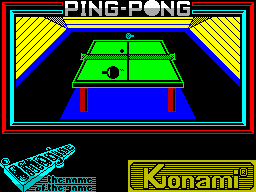
Ping Pong was a conversion of the classic arcade game by Konami. It was released by Imagine Software in April of 1986 and was developed by Doug Burns (or Bernie Duggs) who would go on to create the excellent Hypaball.

Anyway, this classic game was a simulation of table tennis - and was the best version of the sport on the ZX Spectrum by far.

Ping Pong ZX Spectrum

The game followed the rules of table tennis - so the winner was the first to score eleven points. If the game was tied at ten points each (deuce) then the first person to go two points clear of the other was the winner.

The game took a viewpoint of just behind your end of the table, with the table and net viewed in front of you. Player one always took this viewpoint - so the computer or human player two controlled the bat at the 'far end' of the table. The perspective viewpoint on the table was pretty good.

In a nice touch there were onlookers on each side of the table, with the folks on the left cheering every point you won. The 'crowd' reminded me of the spectators that featured in Daley Thompsons Decathlon with the round of applause they gave you on winning a point.

Konamis game played well on the Spectrum Your bat was displayed 'floating' on the screen and the computer controlled it's movement (as in left and right movement). You had to time your shots and choose to go forehand or backhand. You could also slice or drive your shots back - a good variety of shots could be produced once you got the hang of the game.

If a ball bounced up high towards you it was also possible to smash a return back - which could be satisfying as you walloped away another winner.

There were five skill levels to play against (1 to 5) and level five was played at warp speed with your opponent very difficult to beat. I never managed to beat level 5 anyway.

It should be noted that this arcade game featured excellent synthesised two channel menu music (probably the first of it's kind on the ZX Spectrum) which is now down in the history of great Spectrum music.

On Release:
Well the original arcade game by Konami had not been very popular in the UK (I don't know why) so the game did not generate a lot of excitement at first. However, word soon spread about the music and then the gameplay. This game was a superb arcade conversion that was playable and addictive both in single player mode and two player mode. Crash magazine awarded it a Crash Smash rating and rightly so. This game went on to be a big hit on the Spectrum, and another for Imagine Software.

The test of time:
Well after playing this once more I still really like it. It's still playable and once you get the hang of it (all over again!) you realise that a good game is in there. The graphics were never the best, but they serve their purpose and work well within the game. The shots you can make sort of remind me of Wii tennis - in fact a version of this on the Wii would be superb!

This classic arcade game for the ZX Spectrum is definately worth another look after all these years.

We recommend getting hold of the real hardware - but if not then download a ZX Spectrum emulator and get Ping Pong. Alternatively you could try and play it online.

GENRE: Arcade game
RELEASE DATE: 1986
RELEASED BY: Imagine Software
DEVELOPER(S): Doug Burns
PRICE: £7.95 - UK

I put up a brave fight in this classic arcade game. Note the excellent (and ground breaking) theme tune too:

Arcade Games and Classic Games

15 Jan 2010

Spectrum Games - Pheenix - ZX Spectrum Retro Game


Pheenix ZX Spectrum
Classic, classic classic! A real golden oldie this one. Phoenix was an arcade game that was released way back in 1980 by Amstar Electronics.

By the time it was converted to the ZX Spectrum (as Pheenix) by the curiously named Megadodo software in 1983 it was already a bit of a classic game.

Anyway - Pheenix was a very faithful arcade conversion that really did the original game justice - and all within 16K of RAM too!

The game had five skill levels to pick from, and five screens to play through. Like many arcade games from that era - it was a top down viewed shoot em up set in outer space.

Once the various options had been chosen, such as skill levels, the game began with a nice little melody which was qutie like the arcade original (in Spectrum Beeper style). The scrolling stars were in there too.

In screen 1 (your craft appeared at the bottom of the playing area) very colourful 'birds' form up on the screen, one or two breaking formation to attack you. For defence your ship was equiped with a laser cannon and also a funky electro force field that could be activated in those tight spot moments.

Screen 2 was very much like the first but the birds were a different colour (with animated flapping wings now!) and they attacked you more frequently. Luckily you're rate of fire was increased to help you out.

On screen 3 you a not so nice surprise was sprung on you. Weaving eggs were there to be shot at (did the laser fry them?)

Anyway - shooting the weaving eggs caused them to split open with the points awarded inside, the two halves of the egg shooting off to either side of the screen, just as in the original arcade game.

After three passes of the eggs over the screen, the birds inside hatched out, and each flapping creature were more intent on killing you than previously.

I found using the force-field barrier quite useful on this stage as the birds swoop down to crash into you and also drop bombs. The force-field only lasts for a few seconds and then needs a few more seconds to recharge - so a little strategy is needed.

On the fourth screen the birds behave in a similar fashion to those on screen three, but in a nice touch sort of 'squawked' if you hit them with a non-fatal shot.

ZX Spectrum Pheenix - take on the mothership
Finally we come to the most tricky part: The mother ship.
The object here is to destroy the area/barrier beneath the ship and kill the big bird inside.

Once you had popped a cap in big birds ass you were given a congratulatory message before being returned to level 1 - with the game speed increased.

On Release:
Well Phoenix was already a bit of a classic game by 1983, but it had been very popular and a nice twist on the Space Invaders genre. Pheenix was quite popular on the ZX Spectrum and is probably one of the better shoot em ups from the early days of Spectrum games. For those folk that had a 16K Spectrum it represented a sound purhase.

The test of time:
Well if you like a quick blast on a simple shoot em up then you can't go far wrong with Pheenix. It is still playable and fun, and getting past the mothership is quite challenging. Pheenix is a true classic game on the Spectrum and is worth playing again to remind us of the very early days.

Play this again and let the Pheenix rise. You could stay up late and play it you fancy a bit of Pheenix nights.

We recommend getting hold of the real Sinclair hardware - but if not then download a ZX Spectrum emulator and download Pheenix for the ZX Spectrum. Alternatively you could try and play it online.

Please see our other ZX Spectrum games reviews and programmer interviews - all links are in alphabetical order. Cheers guys.

GENRE: Arcade game
RELEASE DATE: 1983
RELEASED BY: Megadodo
DEVELOPER(S): ?
PRICE: £5.50 - UK

Die you viscious alien space birds! Pheenix still plays well...


Classic Games and Arcade Games

10 Dec 2009

Spectrum Games - Pud Pud (in Weird World) - ZX Spectrum retro game

Pud Pud ZX Spectrum
I've been busy lately, these bods at work have had me... working. Pah!

Anyway. Pud Pud was (I think) the first game to be released for the ZX Spectrum coded by legendary programmer Jonathan Smith (or Joffa Smith as he became known).

Ocean unleashed Pud Pud (and Jof) onto the ZX Spectrum gaming public early on in 1985 - and it was generally a well met title.

Pud Pud (in weird world) was a platform flick screen arcade adventure which featured nicely detailled sprites - some of which were a little weird (hence the name Weird World). Already we were being given an insight into Joffa Smiths sense of humour!

Spectrum Games Pud Pud
The aim of the game was simple: Guide Pud Pud around Weird World to find and eat the 10 hidden puddings. Once eaten he could escape from Weird World and presumably go back to Normal World or Pud World.

Pud Pud himself looked a bit like Pac Man with flappy ears/wings which enabled him to fly around the screen. The levels were littered with other creatures, some of which could be eaten to boost your energy, some of which would kill you. It was up to you to find out which creatures had what effect.

One thing was sure: a kiss from Mrs Pud Pud was deadly - and what she was doing in Weird World will forever remain a mystery.

The landscape was certainly different from any other platform game on the Spectrum: It consisted of headstones, parts of broken ZX Spectrums and even bits of the statue of liberty!

Pud Pud in Weird World - ZX Spectrum You began the game with three 'Puds' and each life had a energy level. Running out of energy caused you to lose a life (or Pud) and our rotund hero would explode into a multitude of colours before sinking into the ground - I told you it was a bit bizarre!

The game was quite tricky as the instructions provided gave little insight into what to do - it was up to the player to figure it out.

The locations of all ten puddings was set randomly at the start of the game - the puddings could be collected (and eaten) in any order.

Because the puddings were randomly generated each time you played the game it made Pud Pud a toughie to complete. In a novel twist screens would sometimes change colour - so when you exited a screen then went 'back' onto it the colour scheme would have changed. A Weird World indeed!

On release:
Well Pud Pud was quite well recieved back in the day. Gamers enjoyed the surreal setting, detailled and off the wall sprites, changing colours and the funky music. Pud Pud was something different and something totally new to come from Ocean Software. It went on to do quite well.

The test of time:
Well, if you're a retro gamer who enjoys retro platform games then you could do a lot worse than Pud Pud. It's quite fun to play and does give you a chuckle. It must go down as a memorable Spectrum Game due to it being different from any other platform game on the machine.

Go on - Pud it on. After all, it's the season for 'Pud' ings.

We recommend getting hold of the real Sinclair ZX Spectrum hardware, but if not then download a ZX Spectrum emulator and download Pud Pud. Alternatively you could try and play it online.

Please see our other ZX Spectrum retro game reviews - all links are listed in alphabetical order. Cheers guys.

GENRE: Arcade adventure game
RELEASE DATE: Early 1985
RELEASED BY: Ocean Software
DEVELOPER(S): Jonathan (Jof) Smith, Christine Smith
PRICE: £6.95

The funky title music in Pud Pud:


Pud Pud wanders in Weird World - Spectrum Games:


Classic Games and Arcade Games

23 Oct 2009

Spectrum Games - Penetrator - ZX Spectrum retro game

ZX Spectrum Penetrator
Another fine version of the classic arcade game Scramble, Penetrator was released for the ZX Spectrum by Melbourne House in 1983.

As everyone knows, the game was a right to left scrolling shooter and you had to destroy suface to air missiles and radar stations.

Your fighter could move up and down as well as 'thrusting' forwards and 'braking' backwards.

ZX Spectrum Games Penetrator

The game actually went some way to explaining your crafts movements: The minimum height your fighter could reach was determined by the terrain. Your maximum height was determined by the 'fighter aerodynamics', but could also be limited by the surroundings. So when you entered the underground defence caverns, there would be a rocky ceiling to avoid.

Also, due to the forward momentum requirements of your fighter, you could not stop the craft for any length of time - this is why the game was a constant scroller!

Your fighter was also equiped with a forward firing missile launcher (allow rapid fire) and a bomb launcher to destroy ground targets. Only two bombs could be in the air at one time though.

The enemy radar bases added some depth to the game. The bases did not fire at you, but attempted to track your flight path. They would then send more accurate information to the missile launchers making them more difficult to avoid. Destroying the radar bases quickly was an effective strategy to keeping the 'danger level' to a minimum.

Penetrator on the ZX SpectrumThe danger level was displayed on your console, and continued to build as you penetrated further into enemy territory. There was only one sure fire way to reduce the danger level - blowing up the cool sounding neutron bomb store, thereby damaging the enemy missile command centre. Bwah ha haa!

The game was kept fresh by the varying levels (flying through caverns was quite tricky) and differing enemies. Some levels had paratroopers to shoot and avoid - a nice twist to Scramble!

On release:
Scramble arcade games were all the rage when this game was released on the ZX Spectrum and Penetrator was a pretty good version. The game was quite 'customisable' too - allowing you to run training simulations with unlimited lives, re-define the landscape and even alter the positions of enemy missiles and radar stations. Impressive stuff. Penetrator is a true retro game (check out the opening!) and was popular way back in 1983.

The test of time:
Well Scramble is a classic arcade game, and Penetrator is a pretty playable version on the good old Spectrum. We here in Spectrum Games reckon it's one of the better versions and is definately worth a go. It will keep you amused for a little while.

Grab your joystick and give it your best Penetrator.

We recommend getting hold of the real Sinclair hardware but if not then download Penetrator for a ZX Spectrum emulator. Alternatively you could try and play it online.

Please see our other ZX Spectrum retro game reviews and programmer interviews - all links are listed in alphabetical order. Cheers guys.

GENRE: Scrolling arcade game
RELEASE DATE: 1983
RELEASED BY: Melbourne House
DEVELOPER(S): Veronika Megler, Philip Mitchell
PRICE: £6.95 - UK

Flying ace Major Lawrence Bartle Frere cuts through the enemy in some classic arcade game action:

Classic Games and Arcade Games

4 Jul 2009

ZX Spectrum Game - Pac Man - ZX Spectrum

ZX Spectrum Pac Man
Pac Man is probably one of the most famous arcade games ever, and this conversion by Atarisoft was released for the ZX Spectrum in 1984. The arcade game had first hit Japan in 1980, with units popping up in the USA shortly after. For the ZX Spectrum (and general home gamers) the 1984 release was probably a little too late.

Almost everyone in the known galaxy knows the PacMan game, but for those of you who have been living on Dantooine for the last thirty years, here is a quick rundown:

ZX Spectrum Games Pac Man
The player controlled Pac-Man through a maze eating pac-dots. If you managed to eat all of the dots Pac-Man was taken to the next stage. All the while, four ghosts (Blinky, Pinky, Inky and Clyde) roamed the maze trying to catch Pac-Man. If a ghost touched Pac-Man, a life was lost. Once all lives had been lost the game was over. Pac-Man could be awarded a single bonus life at 10,000 points - if you were a competent player.

Near the four corners of the maze were larger flashing dots known as power pellets. These pellets empowered Pac-Man with a temporary ability to eat the ghosts. When this was active the ghosts would turn a light blue (cyan) colour, reverse direction, and usually move more slowly.

Pac Man ZX Spectrum
When a ghost was eaten, its eyes returned to the 'ghost home' (in the centre of the maze) where it was regenerated. Blue ghosts flashed white before they turned dangerous again and the amount of time the ghosts remained vulnerable varied from one level to the next. The time period generally became shorter as you progressed through the game.

In addition to Pac-dots and power pills, bonus fruits appeared near the center of the maze which could be munched for extra bonus points. These items increased in points value throughout the game.

On Release:
When Pac Man was released for the ZX Spectrum, the arcade game had already been on the go for around four years. Whist still popular, arcade goers and Speccy gamers had been treated to far more advanced offerings, and Pac Man was unfortunately a little bit 'old hat'. Still, it was nice to have an official conversion of the game - (there had been blatant copies of Pac Man such as Munchman) it's just a shame that the ZX Spectrum could not quite capture the magic of the original game. The famous Pac tune and sound effects could not be reproduced which was (and still is) part of Pac Man's charm.

The test of time:
Unfortunately old father time has not been kind to the ZX Spectrum version of Pac Man. Here in the land of ZX Spectrum games we acknowledge that Pac Man is a landmark in gaming history - but this version here is not a landmark in ZX Spectrum gaming history. The version was barely adequate at the time, and these days it really does not hold up. Worth a go purely for nostalgia.

GENRE: Arcade Game (Pacman Game)
RELEASE DATE: 1984
RELEASED BY: AtariSoft
DEVELOPER(S): AtariSoft
PRICE:?

The Speccy version of Pac-Man does not quite manage to capture the magic of the arcade game:


Classic Games, Arcade Games and ZX Spectrum Games

18 Jun 2009

Spectrum game - Pyjamarama - ZX Spectrum retro game

ZX Spectrum Pyjamarama
Pyjamarama was another outing on the ZX Spectrum for working class hero Wally Week, who had first appeared in the game Automania. Mikro Gen had created a great character in Wally Week, and Pyjamarama was another great outing featuring the same game character.

Mikro Gen would go on to develop other 8-bit games featuring Wally and other members of his family.

The concept of this arcade game was slightly bizarre. In the game our Wally was asleep - and you took control of him 'inside his nightmare'. The character was suitably atired in a pair of pyjamas and a night cap. The aim of the game was to find the key that would wind the alarm clock to wake him up in time for work (in the car factory that was the setting of the previous game Automania - clever huh?).

ZX Spectrum Game Pyjamarama
As the game took place inside a nightmare (inside Wally's house), the surroundings were suitably surreal. Sharp items such as axes flew through the air, ghostly apparitions floated around the rooms, hands rose up through the floorboards to snatch at your ankes and there was also a room with the floor that seemed to prevent you from getting anywhere no matter how hard you tried to run (we've all had that dream eh?).

Controlling Wally was simple enough, move to the left, move to the right and jump. There were a lot of objects to collect around the dream house, most of which served a purpose and had to be used to progress through the game. The more objects you used would open up other areas and the percentage of the game completed would increase - this was your overall score (rather than a straight points scored system).

The difficulty with this was not only finding where to use the objects, but was the fact that you could only carry two items at a time. Carefull planning was needed to progress throught the game.

Coming into contact with a nasty would drain some of your 'snooze energy' which was represented as a glass of milk. Nice novelty. The more contact with nasties resulted in the milk level lowering towards the bottom of the glass. If it reached the bottom then it was game over, and poor Wally would sleep in for work (and probably be fired!). It was possible to top up your snooze energy by eating food that was scattered throughout the game.

In another novel twist, one of the rooms in Pyjamarama was called the 'Video Games' room, and if you entered it you could play a nice version of space invaders!

You could move Wally left and right and fire knives and forks (instead of lazer bolts) at the invaders, which were unusual things such as roast chickens. This all sat in with the bizarre feel of the game, and not at all bad since you were getting a game within the game.

Pyjamarama was a nice variation of the platform genre, and the large and colourful graphics (which really highlighted the attribute clash of the Speccy!), bizarre setting and humour ensured Mikro Gen had another hit on their hands.

On Release:
A lot of people had a soft spot for Wally Week, and Pyjamarama did not disappoint. Platform games which included elements of puzzle solving were very popular on the ZX Spectrum in the mid eighties and this offering was certainly one of the better titles in this genre. It was awared a Crash Smash and gave Mikro Gen another big seller.

The test of time:
We here in the land of Spectrum games reckon that Pyjamarama still holds some appeal in a retro gaming way. The colourful graphics and setting has a fair amount of retro charm, and the built in Space Invaders is actually better than some stand alone versions that came out on the ZX Spectrum. Pyjamarama is tough to complete - there are plenty of puzzles to solve and steps to re-trace. I doubt that I would have the patience to be honest. It's worth a look for nostalgia and for those that remember Wally.

So, stick on a before bed and give it a go. If all else fails go to the video games room!

We recommend getting hold of the real Sinclair hardware but if not then download a ZX Spectrum emulator and download Pyjamarama for the ZX Spectrum. Alternatively you could try and play it online.

GENRE: Platform game (Arcade Game)
RELEASE DATE: November of 1984
RELEASED BY: Mikro Gen
DEVELOPER(S):
PRICE: £6.95 - UK

Wally explores his dream world in another of our classic games


Arcade Games, Classic Games and ZX Spectrum Games

10 Jun 2009

ZX Spectrum Game - Paperboy - ZX Spectrum

ZX Spectrum Paperboy
Another ZX Spectrum arcade conversion from Elite Software, who were becoming respected for creating good quality versions of popular arcade games on the ZX Spectrum. Once again this retro biking game Paperboy holds fond memories for many gamers.

Atari released Paperboy back in 1984, and it captured the imagination due to it's different concept and rather cool 'handlebar' controls. Elite software (who had already succesfully converted Ghosts and Goblins and Bombjack) won the license and yet again managed to produce a good conversion from Arcade to home 8-bit micro's. The game was well received and scored a very nice 88% in Crash magazine.

Paperboy ZX Spectrum
The game involved controlling a paperboy and as you may have guessed, deliver newspapers to houses. Sounds like fun eh? Well, it was a lot more fun than a real paper-round, I can tell you!

This ZX Spectrum game stood out as being different, and the mid-eighties BMX craze helped to increase it's popularity.

Anyway, riding your BMX you would pedal up a scrolling street (rendered in a nice isometric view) and throw papers from your bike to the houses that wanted a delivery. You would do this by throwing the paper into the residents mailbox to score points. If you missed the house then the residents would not want a delivery on the following day - narky b*stards eh?

It was possible get your own back on these non-subscribers though. Pedalling through the diagonally scrolling landscape, points could also be gained by firing a newspaper missile through the window of a house with a darkened door (a non subscriber). Well aimed newspapers could result in broken window panes, chopped up tomb stones and ruffled dustbin lids.

Anyone with a nasty streak would enjoy zapping grannies out of their bath-chairs as they enjoyed the early morning air, riders could be knocked off mopeds and flower beds could be flattened. Sounds a bit like my neighbourhood come to think of it.

The papers (or ammo) in your delivery bag were displayed on a panel to the right of the screen, and extra papers could be collected by cycling over the boxes of newsprint dotted around the pavements. These top-ups were usually in hard to reach places and required some cute cycling to collect them unscathed.

There was more to the game than just hurling papers around the streets though. Careful cycling was needed to negotiate a variety of obstacles including dustbins, rogue rolling tyres, garden ornaments and fire hydrants. Pensioners would seem to walk into your path deliberately and workmen would not hear you approaching because they were wearing ear-plugs. Skateboarders were tough to avoid as they raced around at high speed, and exploding bombs (it was a particularly rough neighbourhood) would also crop up from time to time.

Contact with any of these obstacles resulted in a collision and the loss of one of your five lives. A scrolling message would appear informing you of what a silly Paperboy you had just been.

The game took place over each day of the week and the paper-round had to be completed before you could head up to the BMX track which was located at the end of town. For some reason targets were dotted around the track and bonus points could be collected for hitting them with a well thrown newspaper.

At the end of the day's delivery you would be shown a report on your progress. For every paper wrongly delivered the house would cancel its order and if too many of the houses un-subscribed then you get your marching orders and it was game over. It was possible to claw subscribers back by delivering all papers on a round. The game did get more difficult as each days of the week went by. If you made it through the week then the game was completed - which was no mean feat.

On release:
This retro ZX Spectrum game was another game that was highly anticipated due to the popularity of the arcade version. The main drawback was the lack of the 'handlebar' controls (which did detract from the game slightly) and the blue/black graphics - the arcade original had been very colourful. Still, the game was playable and fun, and was a pretty good rendition of the original from Atari. The scrolling on the Spectrum was nice and smooth too. The name 'Paperboy' ensured that it was a big hit.

The test of time:
This ZX Spectrum game is really a product of it's era. It still has a degree of playability - and you just know it is a mid 80's game. Once again it is amazing to think that a cutting edge title could be roughly converted into a machine with only 48K of RAM. Steve Lamb and Tony Mac did well with this one.

Stick on a bit of BMX Bandits, down a can of Quattro and give it a go. Just make sure you've got your aim straight.

This retro arcade conversion for the ZX Spectrum is worth another look after all these years.

We recommend getting hold of the real Sinclair hardware - but if not then download a ZX Spectrum emulator and download Paperboy for the ZX Spectrum. Alternatively you could try and play it online.

GENRE: Arcade game
RELEASE DATE: September of 1986
RELEASED BY: Elite Software
DEVELOPER(S): Steve Lamb and Tony Mac
PRICE: £7.95 - UK

Our boy delivers and takes you on a tour of day one in the ultimate 80's classic game

The Retro Brothers Favourite ZX Spectrum Games...

Jetpac Remake